Monday, November 26, 2012

WRITING ABOUT HOYSALA ART & ARCHITECTURE

CREATIONS EXTRAORDINARY - I


 Worshipers rushing into the temple.
 Remarkable work on the lintel, court scenes of Dasharatha and Vishnubardahana adorn the facade of entrance to
  ChennaKesava temple, Belur.
 June to November,2012. Planning , ticketing, cancellation of tickets , new itinerary - soon it was time  to re-visit  temples of Belur and Halebid. I recall what another temple-art lover told me  decades ago : 'Those who have  not seen the temple of Belur have not seen one of the finest in India'. Like the previous visits, I awestruck by the extra-ordinary efforts in crafting the wall-reliefs which attract tens of thousands of tourists to this region of Karnataka ! Now I am sitting in front of the computer, with a 'Folder' full of bewildering photographs of Hoysala art !


Gorgeous wall-reliefs and stunning friezes 
of
Western face of Kedareswara temple, Halebid.
I am a little bewildered too - where to start and where to end. I searched and read  many many articles and photo-features in the internet  on  architecture and art of temples of Hoysala period - on temples of Belur, Halebid and Somnathpura in specific. I am wondering if  most of what  can be published have already been published  - text and photos included.

Bearded and bejeweled male drummer - 
one among 3 male musicians on brackets
ChennaKesava temple, Belur.
(Placed among those famous wall brackets of Mohini !!)*

 When at the temple complex at  Belur  and Hoysaleswara temple of Halebid, I noted  constant streams of visitors - local, tourists from other cities and States as well as from foreign countries.  Guides are taking groups around  and repeating their tales over and over again. Somnathpura temple had lot less visitors - still it is no longer a temple forgotten. But , Kedareswara temple at Halebid can be surely termed a forgotten one.

Obeisance of the 'Pandavas'.
Hoysaleswara temple, Halebid.

In a way , it is sad. This temple cannot compete with the sprawling Hoysaleswara temple in terms of size or  display of wall-reliefs as well as friezes , but surely is comparable in terms of quality of  art-work. Tourists  get their eyeful at Hoysaleswara temple and therefore do not explore this temple. We hired an auto-rickshaw to  visit the cluster of Jaina temples and neighbouring Kedareswara temple. Surprsingly, the yound auto-rickshaw driver did not know about the existence of this fine example of Hoysala art ! This shows the ignorance at the ground level of Halebid about the worth of this temple.I found just a Spanish couple and 2/3 Indian tourists there enjoying the  wonderful work of art of  Kedareswara temple.

  Rama the Archer - one of the difficult-to-capture wall-reliefs of 
Rama temple, Belur.

No less surprised I was at two very large and famous book stores of Mysore where I went to search for books on temple art & architecture of Hoysala period. One of them -  'Sapna ' claims to be  one of the largest chain in India ! Apart  from a very well-known book on Hampi and another on 'Torana', there was nothing on temple art of Karnataka at 'Sapna' ! Ditto at 'Crossward'. I would have left with a very poor impression unless a Shop Assistant   recommended a book on 'Mysore and more' plus a history book of Karnataka by Dr S U Kamath.


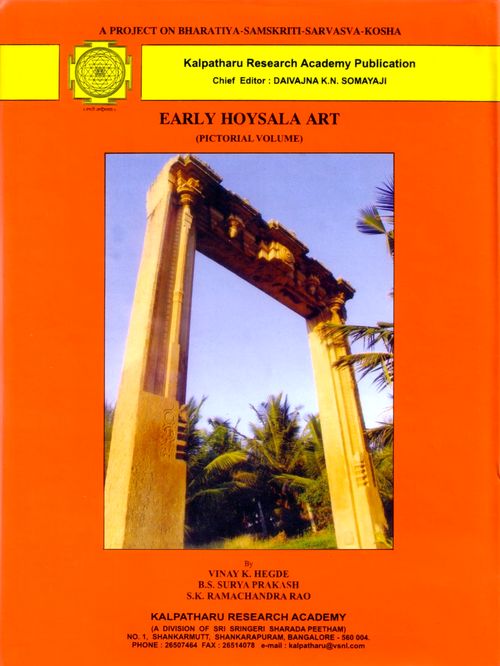
Internet search did not yield   many clues either. I found 2 books of my interesest.One is : Early Hoysala Art by  Binoy K hedge and 2 others , The second one is : Epic Narratves in Hoysala Temples by Kirsti Evans. I doubt if 1978 edition of the book by Sachindranath Maity is any longer available. Those who are interested in  feminine beauty may look for Rekha rao's 'Apsaras in Hoysala Art'.


                                     These reference books were expected at important book stores of Mysore !

  When I  visited Pattadakal complex and Aihole in 2011, I noticed the temple architecture of Badami Chalukyas differ from what we find in Orissa and Central and Western India. The mightiest among the lot - Virupaksha temple of  Pattadakal - has a style statement of its own. Perhaps, architectural details from the twin temples of Siva and SuryaNarayan of  Lakundi also can be referred to in this context.

 Stone pillars - one with  delicate designs and the other 'lathe-turned' - inside Mantapa of 
ChennaKesava temple, Belur.


NOTE  :
*1. This male drummer's  attributes - both physical as well as dress/ornaments - are  to be noted carefully. He is elaborately dressed like a woman, in contrast to the other 2 of the male musicians placed on the brackets/arches. Question I have  - is this a woman incognito ?


   .

Wednesday, November 21, 2012

THOSE ASTOUNDING HOYSALA TEMPLES : JOURNEY BEGINS

BLACK-OUTS AT CHENNAKESAVA TEMPLE, BELUR.

Closed door of Gopuram at 7.25 am. Thin crowd started gathering 
on the steps to attend to early morning prayer. 
ChennaKesava temple, Belur.

 During my early days in school, I used to  be teased  as a 'char-chokho' ( person with 4 eyes) , a common term for boys/girls with specs. By an extension of that logic , Ruby and I can be called 'paanch-chokho' (person with 5 eyes) during our travel, the '5th eye' being our camera.

On our 1st day out  at ChennaKesava temple, Belur, both our '5th eyes' went blank , due to  mal-functioning of batteries , though fortunately not at the same time.

 Ruby and her '5th eye', sitting near
 'Swarga Dwara' of ChennaKesava temple, Belur.

 I use a square battery for my DSLR.Ruby uses 4 pencil batteries for Powershot - a Canon s3is. I carried no spare battery. Ruby had  4 spare Duracell  batteries in her suitcase . After 6 clicks, her camera stopped functioning. We were stuck at the Gopuram. We had 2 choices - walk back to the Hotel ( Mayur Velapuri) and collect the Duracell batteries or buy fresh ones from one of few the  shops just opposite to the Gopuram.

 The shop which helped to keep our '5th eye'  functioning !
Opposite ChennaKesava temple, Belur.


I took the easier option - purchased 4 nos of 2100mAH Kodak batteries for Ruby's Powershot. Well, this move saved our day.Not only Ruby  could keep on clicking till the day-end, this shop-keeper came to my rescue when my camera's battery got discharged and gave me successive shocks.

1st shock came after I clicked only 102 shots. It was around 9.30 am. We decided to return to the Hotel for break-fast and charging the battery. On our way back to the Hotel, we found Canon's LP-E5 battery will have no supplier at Belur. I rang our photographer friend Mr Swaminathan Natarajan of Bangalore who confirmed that for  such a battery , I may have to go to Chickmagalur - 90+ km away !

  Coitus ! 
 'Performers'  shed their ornaments away ! 
1st level of Gopuram ,ChennaKesava  temple,Belur.

 Well  - I managed the day with multiple charging. The Kodak batteries did fine with their pre-charge plus 2 hours charging in the morning while we had our break-fast and freshened up. But, I had a difficult day. Twice - during lunch-break ( we had just a fruit-juice each) and once more after that, I sought help from the shop-keeper  from whom we bought the Kodak pencil batteries to bail my camera out. ChennaKesava knows what I would have done without help from from this guy !

 Nataraja Siva , with all his attributes and in his full glory, 
dances on a lotus . Ganas, Bhringee and worshipers around . 
Hoysaleswar temple, Halebid.

At Halebid on 12/11, I stayed cautious - and therefore, selective .I  faced 2 'black-outs'. 1st one was when I was about to complete round-one and ready to embark on a 'cover-the-ones I -missed'. I focused on one of the many 'Dwarpals' and it was a black-out ! I borrowed Ruby's Powershot for the time being, completed round-one and returned to hotel for lunch, though with great disappointment.

  'Ananta-sayane Vishnu'. 
Wall -frieze  at Hoysaleswar temple,Halebid. 
Captured in mobile's camera after 1st black-out .

At the Hotel Mayur Shantala , after my hard prayer, power-cut was restored  while lunch was served. At Kedareswar temple, I chose only the best wall-reliefs and friezes for clicking. In any case , scope for photography was limited as the 'Garbhagriha' was shut and the northern face was almost inaccessible with bamboo scaffolding. Here, the black-out came when I aimed my camera at an interesting frieze !

  Nataraj dances on 'Apasmara' - one of my last shots 
at Kedareswar temple,Halebid.

After I reached Mysore on 12th evening, I breathed a sigh of relief  sensing that in a town like this a squre battery will not be difficult to get. Well, I missed my heart-beat, when on the morning of 13/11, 2 shops turned me away.It was the 3rd shop which gave me an equivalent make with at least Rs 300/- premium or 'opportunity profit' !

Saturday, October 27, 2012

DURGA PUJA 2012 _ PART II

ICONOGRAPHY OF  MAHISASURAMARDINI -  ' সাবেকী  ' vs ' থিম '  পূজা   
( 'SABEKI', i.e. traditional vs 'THEME' PUJO ).


'No to cloning' -
ShibMandir.

 This time every year ,  argument rages between the groups supporting ' সাবেকী / SABEKI'  i.e. traditional  and ' থিম /THEME'  puja .  Often the ardent supporter from each group  excitedly uses language which further increases the temperature. One such example is here :
https://www.facebook.com/photo.php?fbid=433354780054711&set=a.433354663388056.97877.118216318235227&type=1&comment_id=1300755&ref=notif&notif_t=like&theater.
It is the exchange between Pradipta Nan and Payel Rinks Banerjee on one hand, Shibmandir Durgapuja's representative on the other  prompted me to prepare my submission.


  Durga mauls Mahisasura  - 
Famous traditional depiction at Vaital temple, Bhubaneswar.

 Centuries ago, when sculptors following  canons of Iconography were creating wonders at Badami, Aihole or later at Vaital temple, those who wanted to break with the tradition created the  relief at Mamallapuram where Devi is shown engaged  in combat with Mahisasuramardini . After centuries, another sculptor 'created' a Durga which has 4 hands, no trident  and the severed head of the buffalo  lying at the centre of Devi's feet ! This  depiction seems to have influenced many of our present day artists - I do not have to mention the names.

  Devi has won the battle - she no longer needs ten hands nor weapons. Even the trident is not here.
Severed head of the Asura lies at her feet.


 We can guess the ruckus the purists of those days had raised ! Yet, the wall-relief was installed and stayed put to the delight of Iconographers of these days. I have in my HDD another Durga where she has slain the Asura. Here she  has the trident in her hand.

 During the middle of  the 20th century, we found  many  artists broke from the mould. Reportedly Sunil Pal was  one of the pioneers of this trend. His work of 1945 at Kansaripara  is now forgotten - I could not get any photo of the same from a senior Art critic from whom I heard the 'story'. Later on Jiten Pal took the trend forward during 1950s. I used to admire the tremendous imagination his idols at 23 Pally used to demonstrate . I can still visualise his Durga turning away from the arena of combat with severed head of Mahisasura in her hand, her face and eyes red with anger. As far as my memory goes, she had two hands , not ten. Her dresses were unconventional too. This particular depiction attracted notice and criticism from purists and orthodox  section of  Durga's worshipers. But, Puja Committee of 23 Pally continued to patronise the trend and Jiten Pal .

 Traditional idol - ageold Puja.
Source - Bengali Statesman.

 Since  1950s,not only Jiten Pal , but some more artists started the trend of experimenting with Durga's iconography. In traditional format, Durga stands erect with her right foot on lion's back, left one on Mahisasura, her trident piercing Asura's breast . The implication is : the battle is over. The image is somewhat static.Many artists brought out scene of combat - somewhat like  the famous wall-relief of Mamallapuram -  thereby  a  sense of tremendous movement. During 2011, Bhabotosh Sutar  could portray  such dynamism in his Naktala idol.

One of the finest Durga I have come across - the 'movement' here is captured so perfectly !
Naktala Udayan  Sangha. Bhaboiosh Sutar.

Gradually,over the decades, Durga's depiction changed . These days, we have lots of varieties. Purists have their Bagbazar,Maddox Square,Durga Bari (Ballygunge Place).  Theme lovers have Sanatan Dinda, Tarun De, Shibsankar Das and .... also ShibMandir.

  Iconography of this idol of Durga is not easy   - 
it is important to 'understand' the interpretation before commenting !
95 Palli, Jodhpur Park

I appreciated Shibmandir's concept of merging 'RaktaBeej' and 'No to cloning' ! That neither means Pradipta Nan and Payel Rinks Banerjee will have to like the current (2012)  idol of Durga  of  ShibMandir  nor that  means SbibMandir will get so angry at dissents as to question the grey matter content of such viewers ! But, it is proper  that people like Pradipta Nan and Payel Rinks Banerjee refrain from using rude language.

Each to his/her views and choices !

Thursday, October 25, 2012

DURGA PUJA 2012 - PART I


 Devi and her 'children'- Kartik in far right as seen in this photo - come down a spiral. 
Tarun De. Barisha Udayan Club.
Very lyrical,very graceful posture.

Many photographers - both amateur and professional - who like to chronicle their love for Durga Puja  start their  journey from Kumortuli. These journeys   have produced some wonderful shots , some repeatations. I have  been too lazy to visit Kumortuli for photography - only once I  went there as a child with my grandfather . I reckon this is one experience  I have missed so far.

  Devi among two hemispheres ( lower one in this photo) , within a Pavilion conceived as a 'Kadamba' flower. 
Shib Shankar Das. Santoshpur Triangular Park. 
(Photo taken 14days before inauguration)

  Devi ushering peace. A very tranquil image. 
Shib Shankar Das. Santoshpur Triangular Park.

 This year my association with Durga Puja started with visits to 'sites' where Sanatan Dinda , Shiba Prasad Das  and Purnendu Dey  were working beyond the eyes of the public. I also did a good amount of internet search to  get hold of old photographs of Jiten Pal's work, which brought into contact contact with some veteran Press photographers and finally Naba Pal, grandson of legendary Jiten Pal. More on the work of searching archives at a later date. Though I am yet to get the photographs I was looking for.

 Huge butterfly , installed by Bhabotosh Sutar. Naktala Udayan Sangha.
Looks like a dream when illuminated in the night. 
Devi  envisaged by Bhabotosh Sutar  in spite of  publicity,  a disappointment.

During our 'Puja Parikrama' this year, I have seen  a good no of excellent work. I am also learning to appreciate the great amount of artistic as well as mundane work which go into making an outstanding pavilion and at the same time shaping an idol that stands out in the crowd,stays in the heart of the viewer.
  Pavilion @ Barisha Sarbajanin,shaped as a massive 'SivaLinga' getting ready. 
Sanatan Dinda.


Yet, there are artists who do not get publicity  and their good work is ignored by the prize-giving community, at times by the pandal-hoppers who  are often guided by the Bengali News channels. One major work which has been largely overlooked is Barisha Udayan Palli. Tarun De's work - in Gen Y's language - rocks.

  'ShivLinga' @ Barisha Sarbajanin. 
Sanatan Dinda.

Devi placed within a cut-out on the 'SivaLinga' ,viewed at an angle.
Flames rage on the blue-coloured Linga. Symbols of eye  seem to float on it !
Barisha Sarbajanin. Sanatan Dinda.

 Sanatan Dinda's works in 2012 need elaborate explanation.It has several layers - beyond the obvious visual. More on Sanatan's work in future posts.

Sunday, September 30, 2012

GEARING UP FOR DURGAPUJA 2012 - II

PAVILIONS EX-ORDINARY 2011

 A very traditional idol of Durga.
Singhee Park.

 A broken terra cotta gate and pavilion attracted viewers 
from far & wide. South Calcutta.

When a question like 'Traditional or Theme-Pujo ?'  is placed as a matter of routine to a celebrity by an eager TV Jockey, the most common answer is 'Traditional'. A very safe answer !


 Two neighbouring Puja pavilions - shaped like vermilion container 
and lamp stand.South Calcutta.

I  enjoy the variations offered by the other kind of Durga-Puja - popularly known as ' Theme-Pujo'. It requires thoughts, debates, mobilisation and execution at a different level . If all the 'baro-iyari' pijas in Calcutta were according to traditional model, it would have been quite monotonous. Variations are offered by those organisers who think out-of-the-box and execute variation/s which please/s the viewers' eyes and senses. Ofter, the deity is built and decorated  in a traditional fashion, yet, the surroundings, specially the pavilion is 'built' with lots of novelty.

Chariot - not a very novel thought, but, tidy execution.
South Calcutta.

Here,I present  quite a few examples of novelty . I hope the viewers will like my collection. I end with a very traditional pavilion of South Calcutta.

Singhee Park,South Calcutta.

DOWN MY MEMORY LANE TO HOYSALA TEMPLES

RECOLLECTION OF  BELUR, HALEBID ... AUGUST 1977.......


NOTE - These scanned  1977 photos have been retrieved  from my wife Ruby's album.Please do not copy.

Kedareshar temple (?), Halebid.

UMA-MAHESHASHWARA.
HOYSALESHWAR TEMPLE , HALEBID.
'Those who have  not seen the temple of Belur have not seen one of the finest in India'  : advised me  Pritish Ghosh, an erstwhile colleague of mine in August ,1977, when I was planning our visit to Bangalore, Mysore and Ooty .On his advise, I added Belur, Halebid and Sravanabelgola to my itinerary. The visits were indeed very rewarding. My wife Ruby and I were charmed by the beauty of the bracketed figures of  the main temple of Belur and the wall-reliefs of Hoysaleshwar temple of Halebid.

SIVA AS  NATARAJA ,DANCING ON APASMARA  & BHAIRAVA. 
HOYSALESHWAR TEMPLE , HALEBID.

I am not a person who  remembers small details of a trip decades ago - the smaller impressions are lost. I recollect that we  started from Bangalore early, reached Hassan and Belur around lunch-time and hung around  till sun-set. We reached Halebid  couple of hours after  sun-set. The only food-stall of Halebid was closed for the night and we could not have even  a cup of coffee. Next morning , we started our day early. We reached the temple before eight 8 AM, after a decent break-fast of tea and toasts. The morning was just crisp! There were very few visitors around. And ... the splendour of Hoysala architecture was in front of us , almost taking our breath away.

 SIVA AS NATARAJA. CLEARLY DIFFERENT FROM THE ONE ABOVE. HE IS  DANCING ON A LOTUS , WITH GANAs JOINING HIM IN REVELRY !
HOYSALESHWAR TEMPLE , HALEBID.


Though I carried my SLR  camera and the accompanying lenses with us, I could not locate any photo of Belur temple in our album ! But thankfully, a few photos of Halebid has survived. I have scanned these photos of my 1977 trip . Surely these will  compliment our future collection during the forthcoming trip of November,12.

VAIRAVA
HOYSALESHWAR TEMPLE , HALEBID.

During 1970s, within the 1st few years of our marriage, we visited temples of Puri, Bhubaneswar, Konark, Belur and Halebid. Those days, we  had no formal or informal exposure to temple art , yet, we realised that  temple art of RajaRani temple,Konark and , Belur  and Halebid need re-visits. I recollect  having visited temples of Belur and Halebid 2nd time  during February,2003. I had a day free from official work while on tour in Bangalore which I utilised  in paying a visit to these great sites. But, I had  no camera and could not bring back anything but memory with me.

 A SECTION OF THE FAMOUS STAR OF
HOYSALESHWAR TEMPLE , HALEBID.

 Our February,12 visit to Bhubaneshwar and Konark was really very enjoyable. We had  good amount of time - but, more studies for preparation and thrice the time we spent at each of the temples would have satisfied me.During the coming visit to Karnataka, I would like to return with a good collection from Kedareshwar temple of Halebid and Keshava temple, Somnathpura.


Saturday, August 25, 2012

GEARING UP FOR DURGAPUJA 2012 - I

A STUDY : TREND OF DURGA ICONOGRAPHY 
OF TWO ARTISTS OF CALCUTTA

Durga the warrior- Bhabotosh Sutar,2011

DurgaPuja occupies a very special  space in a Bengali's heart - and I am no exception. The problem is that I do not have a big bag of photos to fall back upon to enliven my memory. The earliest memory of Puja in Calcutta I have is that of a visit to Kumortuli with my grandfather when I was 4 or 5 years old, of the crowd of Sanghasree,Calcutta and  the impressive Durga idols of 23 Pally, crafted by Jiten Pal.

In the past also, I have written about Jiten Pal, one of whose work now stand at a permanent pavilion of  23 Pally/Harish Mukherjee Road. The one which is etched in my memory is of Devi turning away from beheaded Mahishasura , carrying his head in her hand, much like that of the concept of Candika, her face angry yet triumphant.Jiten Pal could create a dynamic posture in a confined space which no one could in his time. That brings me to Bhabotosh Sutar whose 'Durga' at Naktala last year, (i.e. 2011)  had tremendous pace, one of the finest I have come across.

Traditional Durga , slightly heavy face, eyes angry , ornate headgear.

 It will be endevour during months ahead to find out photos of Jiten Pal's work and post them in internet. Let us now return to 2011. 2011 has been a remarkable year for  at least two major artists in the scenario - Bhabotosh Sutar and Sanatan Dinda.


Very unconventional Durga at Barisha Sristi (Behala) , 2005.
Idol of timber by  Bhabosh Sutar.

Bhabotosh Sutar  is quite an innovative artist - I recall his  good work on timber at Barisha in 2005. Those were the days of  early digital camera. Hence the photos were of smaller sizes. Another word of apology - I did not keep a note.Hope, I am not mixing up the artists ! If we compare this idol with what he did at Naktala, his growth will be clear.

Durga vanquishes Mahishasura (in buffalo form - exuding his animal prowess) .  Her sword is her spear. 
What momentum captured in this brass&mahogany idol! 
Bhabotosh Sutar,2011.

 I have a photo of another idol from Tollygunge area , taken during 2008. A typical 'putul-putul thakur' -  doll-like appearance -  of the present decades. Artists around Calcutta have exhausted the possibilities of this type of craft - short hands, static posture, big eyes,soft colour , face directly towards the viewers. Except for .... there is a big 'BUT'. This has a big similarity to the 2011 idol of Bhabotosh Sutar.  When a  scholar will study the transition of  style of depictions in 'Baroyari Puja' of Calcutta over the decades, s/he will dig into such details and chronicle the same.

Long curved horns of Mahishasura ( in buffalo form - here his animal power squashed) split the imagery in two equal vertical parts !   Tollygunge area -2008.

 I have seen the trend of Santan Dinda's evolution as an artist in creating a niche for him in Durga Puja in Calcutta. I have heard that before he started working for Hatibagan Sarbajaneen, he worked in a smaller way in a lane in Kumartuli. I am trying to get a photo of that Puja. But, from whatever I have in my HDD and what are available in internet, one can see Sanatan evolved over the years. He studied  Buddhist and Hindu Tantrik Iconography and assimilated well before he reached the level of 2011. I shall give an example - in 2010, he used the motif of lotus with long vertical stem at Nalin Sarkar Street before making this symbol  a major decoration item  in 2011 at Chakraberia.

 Nalin Sarkar Street, 2010 and Chakraberia Sarbajanin,2011.
Sanatan Dinda evolving .

The white big eyes with black dots as pupils are similar to Sanatan's work at Nalin Sarkar Street in 2004. But, clearly, as an image-maker, Sanatan is evolving every year - a gain for Puja revelers , a path to trail for chroniclers !