Showing posts with label Karnataka. Show all posts

Friday, December 14, 2012

SAVOURING 'ART' OF HOYSALA TEMPLES

CREATIONS EXTRAORDINARY - II


'Built from the wealth amassed from the sword' 
- King Vishnuvardhana, 
in context with his having built ChennaKesava temple,Belur.

To enjoy the temple art of Hoysala dynasty, homework before the trip is a MUST. There are lots of articles in Internet, giving history/timeline and photographs of the  more popular temples around Hassan and Mysore. I  even found a suggestion about a guide  of Belur temple - though  I could not locate him when we were  there during November,12.  Please search for Prof S Settar  and do not miss his interview in Frontline,April,2003.

Trikuta Kesava temple at Somnathpura.

Simply stated, Hoysala temples have a complex building plan with artistic projections aplenty, a 'scroll' of wall-reliefs of deities and other characters unfurling on the 'parikrama' , dazzling female dancers and musicians together with mythical animals staring down at you, rows of  human figures on animals and chariots fighting mythological and real battles. These temples are virtually a  gallery created to educate viewers of  Hindu Iconography and 'naba-rasa' as well as dance   plus music .

Rich wall frieze of Kedareswar temple of Halebid.

Kirat-Arjuna &  Bali-Sugriva duels, Hoysaleswara temple,Halebid.


Vishnu rests on Seshanaga - Lakshmi 'serves' at his feet, Yogamaya sitting near his head. He rests within  a pavilion, with roaring vertical waves filled with fish and tortoise - Vishnu's incarnations.
Kesava temple,Somnathpura.

Note : Interesting to watch one small part in each of the last two panels - Sugriva's right leg & Sheshnaga's tail - sneak out of the frame ! Typical Hoysala style .

And .... not-to-miss the exceptionally carefully executed  layout and 'art-work' in the  interiors of temples.Some of the secular ceiling art , round and serrated ends  of load-bearing columns, female bodies serving as brackets on  top-ends of columns almost hidden in the darkness of 'Mantapa' will not fail to mesmerise discerning viewers. Topping the list are the principal deities wherever we can view their splendour not hidden under silk robes and garlands.

Venugopala, one of the three deities of
Somnathpura temple.

Dancer on one of the four pillars within 'Garbhagriha' of 
ChennaKesava temple, Belur.

Hundreds of figures and motifs curved on famous 'Narasimha' pillar within'Garbhagriha' of 
ChennaKesava temple, Belur.
Notes :1.  It  is said  that this pillar used to revolve on its vertical axis.  
2. Comparable are stone pillars of Vitthala and Hazara Rama temples, Hampi.

Once  a person spends time among the temples built by Hoysala dynasty, it becomes clear that a martial spirit had worked in bringing these temples into being. The name  king Vishnubardhana chose for his lineage and also the symbol are result of this military spirit. We all know, 'Hoysala' means 'Kill Sala', reportedly the uttering of  a sage whose life Sala, a tribal leader and ancestor of the king , saved by slaying a pouncing lion.

My favourite 'Sala slaying the lion'. Sala is in pain , yet he pierces right ear of the beast with his long dagger, held in his left hand !
Wall-reliefs of Vishnu and Kamadeva in the background.
ChennaKesava temple, Belur.

This may be a myth,established  firmly by king Vishnubardhana , while adopting the 'Sala' symbol and sculptures of  'Sala and the lion' in the entries to ChennaKesava temple's 'Mantapa'.


While working within the limitations of 'canon', some of the artists broke ground in their efforts to stand apart among the 'many'.Collectively, the following characteristics will immediately draw attention of the viewer :
Krsna tames 'Kaliya-the-snake'. One of his wives asks for forgiveness 
on behalf of her husband.
Kedareswar temple, Halebid.
  • the decorative features of the wall-reliefs, e.g. the dresses , ornaments and other attributes are carved so meticulously that one feels s/he is viewing a wood, and not a stone-carving.
  • a toe here, a finger there overflow  the frame , just to add drama to the 'scene'.
  • the fierce manifestations of Siva and Shakti are often  not stiff, but in smooth postures of dance.
I end here with ten. nos of photos . More will follow.

Monday, November 26, 2012

WRITING ABOUT HOYSALA ART & ARCHITECTURE

CREATIONS EXTRAORDINARY - I


 Worshipers rushing into the temple.
 Remarkable work on the lintel, court scenes of Dasharatha and Vishnubardahana adorn the facade of entrance to
  ChennaKesava temple, Belur.
 June to November,2012. Planning , ticketing, cancellation of tickets , new itinerary - soon it was time  to re-visit  temples of Belur and Halebid. I recall what another temple-art lover told me  decades ago : 'Those who have  not seen the temple of Belur have not seen one of the finest in India'. Like the previous visits, I awestruck by the extra-ordinary efforts in crafting the wall-reliefs which attract tens of thousands of tourists to this region of Karnataka ! Now I am sitting in front of the computer, with a 'Folder' full of bewildering photographs of Hoysala art !


Gorgeous wall-reliefs and stunning friezes 
of
Western face of Kedareswara temple, Halebid.
I am a little bewildered too - where to start and where to end. I searched and read  many many articles and photo-features in the internet  on  architecture and art of temples of Hoysala period - on temples of Belur, Halebid and Somnathpura in specific. I am wondering if  most of what  can be published have already been published  - text and photos included.

Bearded and bejeweled male drummer - 
one among 3 male musicians on brackets
ChennaKesava temple, Belur.
(Placed among those famous wall brackets of Mohini !!)*

 When at the temple complex at  Belur  and Hoysaleswara temple of Halebid, I noted  constant streams of visitors - local, tourists from other cities and States as well as from foreign countries.  Guides are taking groups around  and repeating their tales over and over again. Somnathpura temple had lot less visitors - still it is no longer a temple forgotten. But , Kedareswara temple at Halebid can be surely termed a forgotten one.

Obeisance of the 'Pandavas'.
Hoysaleswara temple, Halebid.

In a way , it is sad. This temple cannot compete with the sprawling Hoysaleswara temple in terms of size or  display of wall-reliefs as well as friezes , but surely is comparable in terms of quality of  art-work. Tourists  get their eyeful at Hoysaleswara temple and therefore do not explore this temple. We hired an auto-rickshaw to  visit the cluster of Jaina temples and neighbouring Kedareswara temple. Surprsingly, the yound auto-rickshaw driver did not know about the existence of this fine example of Hoysala art ! This shows the ignorance at the ground level of Halebid about the worth of this temple.I found just a Spanish couple and 2/3 Indian tourists there enjoying the  wonderful work of art of  Kedareswara temple.

  Rama the Archer - one of the difficult-to-capture wall-reliefs of 
Rama temple, Belur.

No less surprised I was at two very large and famous book stores of Mysore where I went to search for books on temple art & architecture of Hoysala period. One of them -  'Sapna ' claims to be  one of the largest chain in India ! Apart  from a very well-known book on Hampi and another on 'Torana', there was nothing on temple art of Karnataka at 'Sapna' ! Ditto at 'Crossward'. I would have left with a very poor impression unless a Shop Assistant   recommended a book on 'Mysore and more' plus a history book of Karnataka by Dr S U Kamath.


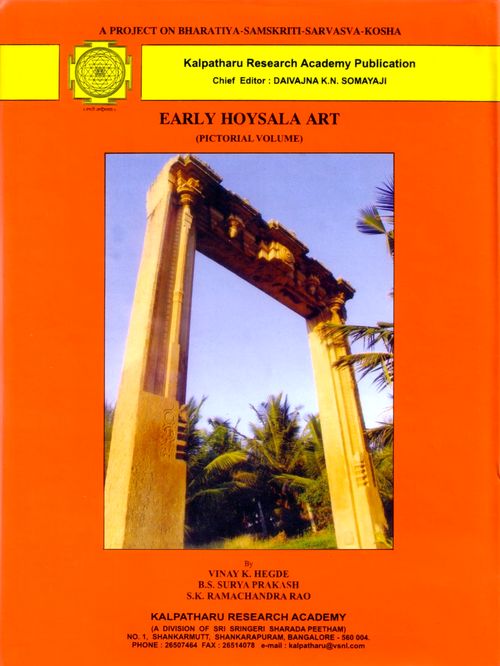
Internet search did not yield   many clues either. I found 2 books of my interesest.One is : Early Hoysala Art by  Binoy K hedge and 2 others , The second one is : Epic Narratves in Hoysala Temples by Kirsti Evans. I doubt if 1978 edition of the book by Sachindranath Maity is any longer available. Those who are interested in  feminine beauty may look for Rekha rao's 'Apsaras in Hoysala Art'.


                                     These reference books were expected at important book stores of Mysore !

  When I  visited Pattadakal complex and Aihole in 2011, I noticed the temple architecture of Badami Chalukyas differ from what we find in Orissa and Central and Western India. The mightiest among the lot - Virupaksha temple of  Pattadakal - has a style statement of its own. Perhaps, architectural details from the twin temples of Siva and SuryaNarayan of  Lakundi also can be referred to in this context.

 Stone pillars - one with  delicate designs and the other 'lathe-turned' - inside Mantapa of 
ChennaKesava temple, Belur.


NOTE  :
*1. This male drummer's  attributes - both physical as well as dress/ornaments - are  to be noted carefully. He is elaborately dressed like a woman, in contrast to the other 2 of the male musicians placed on the brackets/arches. Question I have  - is this a woman incognito ?


   .

Wednesday, April 6, 2011

IN PURSUIT OF SIVA ICONOGRAPHY - IV

COMBAT BETWEEN HARI-HARA  AND THE LINEAGE FROM KASHYAP & DITI

During our February,2011 'pilgrimage' to the land of Saivites, as we went from temple to temple of SriMukhalingam, Badami, Aihole and Pattadakal, we could see that the kings and their team of visualisers   wanted to present images of Siva,Vishnu and other gods, including MahishaMardini and SaptaMatrkas engaged in battles to the worshipers. While SivaLinga was placed in the inner sanctum, wall-reliefs and the scenes carved on the pillars depict the combat scenes.

I picked up two photos - one each  of Siva and Vishnu - relaxed and at peace.

 Siva leaning against Nandi.
Mallikarjuna temple,Pattadakal,Karnataka.

 Vishnu rests on Ananta the snake while Lakshmi and Saraswati give him company.He would soon be engaged in battles against Hiranakshya and Hiranyakashipu.
Famous fresco from SriKurmam temple,SriKakulam,A.P.  
NOTE : From any point on the corridor where this fresco is painted, it would seem that Vishnu's eyes are focused on you !

Mythology  has layers of tales,allegories and worshipers of various deities adding their beliefs as spices ! These stories are never linear in nature and are subject to the view points of the writer - OR the person who interprets ! Therefore,  stories of the conflicts the mightiest among the gods had with the lineage from Kashyap and Diti may be differently perceived by others - my apologies to them .

Diti was one of the wives of sage Kashyap. Kashyap - a much-married sage - fathered Adityas through Aditi, twin sister of Diti, Danavas through Danu and Nagas through Kadru. Diti's conception has a story with a twist - she was jealous of her sister's sons and invited Kashyap to bed at the time of twilight. Kashyap advised her to be patient, suggested not to invoke wrath of Rudra and his companions who roam around during the hour of sunset. Diti was restless. She tugged at his clothes  and Kashyap yielded.Later Diti understood her mistake and braced for tragedies of her sons' lives.

 Vishnu in his boar manifestation - Varaha Avatar.He has brought  Bhudevi - the Earth goddess from the bottom of the ocean - she rests on his lower left hand on a lotus.His own left leg rests on a lotus too.His other three hands carry 'Chakra' - the wheel, mace and conch. Nagaraj , gods and other celestial beings worship him and celebrates Bhudevi's appearance.
Cave of Vishnu, Badami, Karnataka.

Diti gave birth to Hiranakshya and Hiranyakashipu who grew to be great warriors. They defeated the gods and  their arrogance brought upon their death at the hand of Vishnu.

Hiranakshya adopted Andhaka ( vide my story on Andhakasura ,posted a few days ago ) - he also grew up to be a great warrior.He challenged Siva and was nearly killed by him.After  'a  thousand years' of punishment and equally long  penance , he  was let free and allowed to join  Siva's 'Ganas' as Bhringee.But, Gajasura - a close associate of Andhaka - was killed by Siva.

Siva slaying Gajasura. At least three Matrkas are present in this wall-relief.Siva is ithyphallic and Nandi looks upwards.If the skeletal figure next to Siva's right leg is of Bhringee  ( Andhakasura before his penance ) - then I would say : it is  tragic, it is an irony of Andhaka's destiny that he had to witness the demise of his erstwhile associate and friend ! 
SriMukhalingam, SriKakulam,A.P.

Hiranyakashipu's son Pralhad was a great devotee of Vishnu - there was no conflict in this generation.Later, gods and Daityas collaborated in churning of the sea - but gods took away all the goodies including the divine elixir . Thus, the temporary truce was broken.There was prolonged battle when Prahlad's grandson  Bali was chosen the army-chief of the Daityas  and was pitted against Indra.Bali was a great warrior, he could not disposed of in face-to-face battles,  - we shall come back to the tale of his manipulation a little later.

NaraSimha in action. Here, his gestures more terrifying than those @ Hampi and Aihole.
Virupaksha temple, Pattadakal,Karnataka.


If we look back to the episodes so far, we shall find the Devatas - the gods - were rescued by  either Vishnu or Siva again and again. Vishnu's third manifestation - Varaha Avatar - rescued Bhudevi, the goddess Earth from  the depth of ocean when Hiranakshya was slayed.His next manifestation - Nrisimha Avatar - killed Hiranyakashipu.From the gods' point of view, these slayings were big reliefs for them. The mythological stories have been written by devotees of Vishnu - who can tell if he were partisan or not ?

Partisan he was.During the collaborative phase of Devatas and Daityas, Visnu posed as a beautiful woman - Mohini - and 'her' charm deprived the Daityas of their rightful share  of the divine elixir.

Before I move to  Bali's end  as a mighty ruler, Siva's  big contribution to churning of the ocean must be mentioned . This exercise was mostly controlled by Vishnu. He helped the gods at every stage - yet, at a very critical juncture, Siva lent his big support to this event.  Vasuki ,the snake used as the 'rope' for churning, was greatly stressed and vomited poison. All those engaged in this operation were very badly affected. Siva  drank the poison to the world's relief and his throat turned blue forever - he is now called 'NeelKantha'- the blue throated god - by his devotees. I have not found any wall-relief  on this episode at Pattadakal or Aihole. But, Samudra Manthan

 Emergence of Lakshmi. The ocean is getting churned - on the right , Daityas holding the head of Vasuki .Gods,on the left ,hold his tail .We see 'Uchchaishraba' the horse and 'Airavat' the elephant among other treasures this churning yielded. 
Mallikarjune temple,Pattadakal,Karnataka.

Now back to Bali. Bali survived the battle with the gods. He stayed at the top  and kept on ruling the world. When he could not be dislodged by the gods. a manifestation of Vishnu - BamanAvatar - came to their rescue. Vishnu posed as a short Brahmin and  came to Bali's court  as a alms-seeker. He asked for land just enough for three steps of his. When Bali granted his wish , he did not know he was being tricked by Vishnu into a situation from where he would have no escape.Vishnu grew into a size  extra-ordinary.His first step filled up  the e-n-t-i-r-e kingdom of Bali, his body filled up the sky and his arms blocked the eight directions. His second step filled up the heaven  and his third step - well there was nowhere any place for it. I just now read the exchange between Vishnu and Bali as written in BhagavatPurana - and Bali emerges as a great soul..... though he understood that he was tricked by Visnu incognito,  he offered his head for the third step.

Trivikrama in his full glory.The world worships him. Bali is shown as uprooted in this famous sculpture. According to what I read,Vishnu's third feet was placed on his head and he was then removed from the heaven which was restored to the Devatas.
MahaVishnu caves,Badami,Karnataka.

History repeated itself.Bali's father Virochan was deprived of his life by the gods as they came to his palace posing as alms-seeker Brahmins ( 2nd paragraph, nineteenth chapter, eight canto). Well, from our mythology, we often find the gods were not always great ! And , often, quite unfair.But, Bali's treatment at the hand of Vishnu ( or his feet ! ) leaves me sad. The story-tellers have applied soothing ointment to his banishment from his throne and kingdom to the 'underground' (...'paataal...') by adding that he was offered a beautiful abode ('...sutal...' in Sanskrit) built by Vishwakarma and the position of 'Indra' in 'Sabarni Manwantar' , but,it reminds me of the many unfair deeds of the protagonists of Mahabharata and Ramayana.

I end with a photo of Hari- Hara, standing together with Siva - ensuring the support extra-ordinary to their clan of gods !

On the left, stands Siva with two arms , his trident with a coiled snake, a smiling skull on his piled matted hair.His left hand rests on his thigh in KatyaValambita posture.His right foot is in anchita and left in sama postures.Hari-Hara in Siva's left has four arms.Siva's half  is in the right, with his  third eye, crescent moon and snake.Vishnu has the conch in his upper left arm, his lower left hand gain in KatyaValambita posture. Both the feet are in sama posture.
RavanaPhadi, Aihole, Karnataka.


1.Reference : 7th and 8th Cantos,SrimadBhagataPurana - Bengali translation by Sri Taaraakaanta Kaabyatheertha.
2.Siva in dance,myth and Iconography - Ann Marie Gaston.
3. Mr  Palahali, my 'friend' in sulekha.com brought to my notice a 'story' on Prahlad/Bali - a blog of his.This was 3 years ago. in response to a blog I wrote on Mahisasura  - a story of this Asura's viewpoint.My submission - I did appreciate Mr Palahali's blog a lot , but what I wrote here is completely my view-point.

Thursday, March 31, 2011

SCRAPBOOK : OUR JOURNEY THROUGH THE LAND OF SAIVITES - I

OUR SCRAPBOOK  of  TRAVEL TO  SRIKAKULAM , BADAMI & AIHOLE


Ruby, me and Aihole. 
The entrance of DurgaGudi with
Aihole Museum's outdoors's displays in the background.

During this February,'11 trip to the land of Saivites, I have  taken just a few photos of people and landscape.What I have in my HDD  to-day are mostly related to Iconography.Looking back, this is a lost opportunity for me.After a few years, I  shall not be having much of a scrapbook from this visit to refer back ! I should have been more conscious about this aspect while moving around.Fortunately, Ruby  has been more methodical and her album  fill in  some of the gaps.

 Sea-shore @ BandarwaniPeta near SriKakulam. Fishermen's boats near the horizon.The stone formation bang on the shore is nice for photography from a distance, specially when waves break into the same.Unfortunately, it is an open-air toilet for the villagers! 
Had to stay quite a distance away from the same.

Catch of fish, lying on sand at the sea-coast.

 These children were playing on the coast - requested me for clicking a photo 
as we were returning to our car.

SriKakulam has a  sea-shore at BandarwaniPeta - accessible by car and bus -  which is very different from the normal   tourist destination. It has a strong presence of fishermen - the seacoast is full of boats and fishing gears like nets. We could see several boats on the prowl in the sea. It is obvious that the main activities take place during the night. The neighbouring  LightHouse/Watchtower was out-of camera's range. The confluence of river Bansadhara and the sea may be a spot where one can sit down and relax - but, the coast where we stood for a while and took photos had an unpleasant stench of fish and open-air toilet around a big mound of stone which was getting splashed by waves at regular intervals !

 The untiring doorman -'DwarPal' - @ Badami caves. 
Looking after thr gods' abode since 534 AD !

Shadow & light - street photography @ Badami

Badami offers two magnificent views to those who care to move around with binocular and/or camera. Once on the top level of the caves  temple, we find the small town around, its sky-line with two near-by mosques from the AdilShahi era of Bijapur, Agastaya Teertha with  sprawling 'ghat' around, Bhoothanatha temple complex  cradled here, a hillock on the other side of Agastaya Teertha with Malegitti  Sivalaya on its top. From the other side of Agastaya Teertha, we can see the hillock with Badami caves and a fort on its top . To serious photographers, 'ghat' is an important subject.But, when I reached a reached Agastaya Teertha's 'ghat' , it was well-past noon, bathers have left for lunch and afternoon siesta.

 Skyline of Badami - photograph taken from platform in front of the caves.

View of  AgastyaTeertha from Badami caves.

Wednesday, December 22, 2010

IN PURSUIT OF SIVA ICONOGRAPHY - I

PILGRIMAGE  EXTRAORDINARY !


This is my season of thanksgiving! Before Ruby and I embark on our journey through AP and North Karnataka in pursuit of Siva/Shakti/Vishnu iconography.

My interest in Siva iconography was kindled by the books I could lay my hands on @ NY Libraries - at Schwarzman Building  and Lincon Center. Three  from the books I went through were presented to me on the eve of our departure by my elder son  Sujash and his friend Miriam .Two rounds of thanks go to them.

Bhiksatana Siva from temple @ Kanchipuram (not in my current itinerary)
(Photo used from Internet)

Special thanks go to my e-friends who have spent valuable time in advising me about the logistics and other innumerable details of the trip I have planned for February,11.

Siva and Vishnu are two major deities of  Hindu religion, worshiped across the country.Vishnu has ten 'manifestations -Dashavatar - whereas Siva has none.Most of Siva temples have SivaLinga and a few have an idol like the following :


Siva-Shankara-Bhairava @ a temple in Chittorgarh,Rajasthan

But through the ages, Siva's imagery has gone through lots of changes. He has been visualised , through centuries,as  the following, perhaps many more :
  • Pasupati of pre-Vedic ages.
  • Rudra, the Archer of Vedic hymns.
  • Bhikshtana Siva, Androgyneous Siva
  • Kalyana Murti,Gajasura-sanhara Murti,Gangadharana Murti etc
  • Bhairava, Kal-Bhairava
  • Nataraj and
  • Linga
Who knows if some of the later ones were based on heads of sects practising Saivism ? A great disciple was transformed , in the followers' mind as an 'avatar', an incarnation of Siva. Foremost example - Lakulisha .I believe, imageries of Bhairava and KalBhairava  were connected to real lives.

Those who are very much interested may please read the excellent and handy compilation of Margaret Stuteley :


Ruby and I  hope to capture many of Siva's imageries during this 'pilgrimage'.  And those of Shakti and Vishnu too.We shall not be able to savour the beauty of miss the Ganges and majestic Himalayas like  the pilgrims to Kedarnath and   Badrinath  . Instead, here, my bonus will come from another 'H' - history. And the Tungabhadra, the river which inspired novelist   Saradindu Bandopadhyay.