Monday, January 10, 2011

GEMS FROM AN UNKNOWN ARCHITECTURAL RUINS IN GUJARAT


Camels  we met on en-route Vadnagar


One of the two 40' 'Toranas'

I love to visit historical sites - but, I did not utilise my stay and visits to Gujarat for travelling for pleasure,except for the last one in 2009.This was when Ruby and I visited Ahmadabad in late August of that year.I was there in connection with our PANIIT's project - 'IITians for ITIs'. I was visiting several  ITIs in Guajarat - together with the Dy. Director of ITI,Tollygunge - to study their association with Industries and introduction of ISO in ITIs.


Details of the intricate work on a 'Torana'

On the 2nd day of our stay, we visited, among other places, an ITI at Vadnagar. I learnt much later that Vadnagar's history very likely, dates back to Harappan civilisation.Our hosts did not touch upon  this aspect , but after lunch,  took us to a  12th century ( Solanki period) archaeological site showcasing the 'Toranas' on the bank of Lake Sharmishtha. Some people believe - I learnt later from internet sites - that the 'Toranas' were part of a big palace or temple complex , built elsewhere and now transplanted in the present location.There is very little of the  complex  in the vicinity of the 'Toranas' , except for some stone slabs, with reliefs,statues and motifs. Those were   found strewn around. I  have read that a lot of them have disappeared - the ones which survived  - are neatly arranged.I took photographs of some of those few  preserved in the location.


One of the several Saiva imageries that survived ravages of time. Here, Siva has four arms. View http://www.trekearth.com/gallery/Asia/India////photo1268068.htm for a ten-armed Kala Bhairava

The 'Toranas' are about 40' tall. They have several 'Makara' motifs on them, much like the 'Yalis' of South India. There are deities and social scenes carved in stone.The statues and motifs have suffered a lot of erosion - a lot of the details were left to my imagination.Some of the interpretation is my imagination !


View of the top of the magnificent 'Torana' top. At the centre, Kartikeya sits in in yogic posture - we can see his three faces only . His peacock is  at his feet. Is his consort Devasena on his left ? 'Makara' motif appears repeatedly.


On the left, Uma  rests on the left thigh of Siva . On the right, we see a naked woman stooping to touch the feet of a man coming towards her.Two on lookers, one standing and one in a sitting posture placed in the background. What the man in the right flank trying to do ?

This one is ,very likely, an erotic wall relief .A very interesting  wall relief of this site is my last entry for this   blog of mine .


Wife 1 pulls at the hair of wife 2 while the husband tries to bring the temperature down !!

Note - Please refer to http://vadnagar.blogspot.com/   for more details.

Wednesday, December 22, 2010

IN PURSUIT OF SIVA ICONOGRAPHY - I

PILGRIMAGE  EXTRAORDINARY !


This is my season of thanksgiving! Before Ruby and I embark on our journey through AP and North Karnataka in pursuit of Siva/Shakti/Vishnu iconography.

My interest in Siva iconography was kindled by the books I could lay my hands on @ NY Libraries - at Schwarzman Building  and Lincon Center. Three  from the books I went through were presented to me on the eve of our departure by my elder son  Sujash and his friend Miriam .Two rounds of thanks go to them.

Bhiksatana Siva from temple @ Kanchipuram (not in my current itinerary)
(Photo used from Internet)

Special thanks go to my e-friends who have spent valuable time in advising me about the logistics and other innumerable details of the trip I have planned for February,11.

Siva and Vishnu are two major deities of  Hindu religion, worshiped across the country.Vishnu has ten 'manifestations -Dashavatar - whereas Siva has none.Most of Siva temples have SivaLinga and a few have an idol like the following :


Siva-Shankara-Bhairava @ a temple in Chittorgarh,Rajasthan

But through the ages, Siva's imagery has gone through lots of changes. He has been visualised , through centuries,as  the following, perhaps many more :
  • Pasupati of pre-Vedic ages.
  • Rudra, the Archer of Vedic hymns.
  • Bhikshtana Siva, Androgyneous Siva
  • Kalyana Murti,Gajasura-sanhara Murti,Gangadharana Murti etc
  • Bhairava, Kal-Bhairava
  • Nataraj and
  • Linga
Who knows if some of the later ones were based on heads of sects practising Saivism ? A great disciple was transformed , in the followers' mind as an 'avatar', an incarnation of Siva. Foremost example - Lakulisha .I believe, imageries of Bhairava and KalBhairava  were connected to real lives.

Those who are very much interested may please read the excellent and handy compilation of Margaret Stuteley :


Ruby and I  hope to capture many of Siva's imageries during this 'pilgrimage'.  And those of Shakti and Vishnu too.We shall not be able to savour the beauty of miss the Ganges and majestic Himalayas like  the pilgrims to Kedarnath and   Badrinath  . Instead, here, my bonus will come from another 'H' - history. And the Tungabhadra, the river which inspired novelist   Saradindu Bandopadhyay.

Friday, December 10, 2010

A NEWYEAR'S GIFT FROM A TRAVEL-PHOTOGRAPHY-FREAK


The 'SURPRISE' Gift


When DJ Ray insisted on getting my address as he wanted to send a 'New Year's Greetings' by post, little did I expect the surprise he was readying for despatch!!

I came to know DJ Ray through flickr.com. When I was studying about Iconography of Siva during my stay in New York  June-August, 2010, Those days, I spent a good amount of time on Internet resources looking for materials on this subject.This is when I came across photos of DJ Ray and Mukul Banerjee , covering wall reliefs from Badami/Aihole/Pattadakal.

I left an elaborate  comment on his photo of  'Nataraja Pattadakal', highlighting the details from the viewpoint of Siva's Iconography ( view : http://www.flickr.com/photos/djray1943/4718038964/) , thus earning his acquaintance. The reward came yesterday noon. It is a 12-pages table calendar, printed on glossy paper. Each page....26.5 cmX 22 cm in size....contains 22.5cmX13cm photos of architecture/reliefs from Hampi/Badami/Aihole/Pattadakal clicked by DJR.


What a wonderful gift! Thanks a lot DJ Ray!


Readers of this page - please take your time to appreciate this person's pages of wanderlust in http://www.flickr.com/photos/djray1943/with/4718038964/.

Saturday, October 16, 2010

DURGA PUJA IN CALCUTTA - 2010

A FEW THOUGHTS ON THE EVENING OF  NABAMI


The earliest  images of Durga Puja I recall is  of  a village in Murshidabad district , known as  Shimulia , wherefrom the family of my mother originates. My grandfather, who was a doctor in Calcutta, had his establishment in Shimulia village. I recall the Candimandap, the Goddess in Her full glory, the priest's puja offering in chaste Sanskrit and sacrifice of goats on Sandhipuja and Nabami. My grandfather's elder brother would match the crescendo of  the dhakis' percussion with loud calling out  of prayers  during the moments of sacrifices. Later, I  realised, he ... and the priest , Bhondul masai.... used to be under the influence of alcohol at those moments.

After my grandfather expired,  fund flow  for this Durga Puja dried up. Later, as my uncles did nor take any interest in their ancestors property, their relatives sold off the buildings and landed property piece by piece.
The Candimandap is now nearly flattened, but for a small portion where idol of Maa Carcikaa.... worshiped by the family for generations.....has been kept. With a son of my mother's cousin's family getting financially established and being in a position to revive the tradition. I did not have an opportunity to be present at Shimulia this Puja (2010), but, offer my prayer to the deity as I found Her last February when Ruby and I visited Shimulia village .


Decades after, in my sixties, I have collected a good number of  Duga Puja's photos. Since I purchased my 1st digital camera while @ Durgapur , I have taken scores of photos of  Puja for many years. I am no longer young, I  visit   a few pandals in Calcutta in the vicinity which have earned good name for splendour and artistic merit. A good representation  of  current days style of decoration and display  I have collected through years !


One of the best  idols I have seen is here :


 I do not like the doll-like idols which have become quite popular these days in Calcutta. Initially, this style  appealed a lot , but now , repetition  has rubbed off the novelty. Here is a photo of one such idol which is a few years old. I was quite fond of this style .... but too many copies have now been made. The advantage of  having such an idol has probably a relationship with cost. This type of  idol is relatively small in size and therefore organisers do not have to shell out a fortune for the kind Ballygunge Cultural or Ekdalia Evergreen needs. So,  other attractions like pandal decoration gets a good share of  the collection .


But,  the hype in media  before and during the Puja days have brought a question in my mind. There is a lot of emphasis on the crowd a Puja pandal attracts. We find a spirit of carnival among the revelers ! The more is the publicity, the more crowd the pandal pulls.... thus attracting larger Corporate contribution. I often wonder, so much time goes into planning  a pandal's shape and decoration and hundreds of man-hours go into creating it ,  do not   fare appreciation from the swelling crowd. Thousands of people streaming through the In- and Out-  gates get just a glimpse of the splendour created as the volunteers herd the people at every stage. If one has to savour the 'creations', only time to visit is early mornings .... when lighting cannot be enjoyed.... and the evenings of Dashami/Ekadashi , when crowd pressure is minimal.I remember once Badamtala Puja committee had displayed a style based Kalighat's pata. I went in the evening of Ekadashi and could take as many photos as I wanted to , because there was a handful people around. but, then , the maximum number pandals one can cover will be between 10 and 15, hardly more !

Tuesday, August 24, 2010

SIVA THE ICON -III

SIVA  & JESUS - ARGUMENT on ASCETIC /EROTIC  IMAGERIES.


Nataraja Siva from Srimukhalingam temple, AP, India. Siva has Nandi on his right and Devi on his left. His ithyphallic image beautifully poised, exudes cosmic joy and power.


Siva is a major deity of Hindu religion. Through centuries, millions of followers  have worshipped him. His imagery's , as we find in Sanskrit and vernacular texts, in temples and caves ( Elephanta, Ellora et all),paintings vary widely. He can be Shankar the Benevolent,  Bhairava the Ferocious, Nataraj the Cosmic dancer, Lakulisha the Ithyphallic yogi.  Sects of Saivites , through centuries of practices, built up Siva's imageries with conflicts among them.Not all the sects believed in being celibate ascetics. Nor  the Vaishnavites among Hindus always been kind to Saivites while penning puranas and other religious scriptures. Tale of Siva and the wives of sages in the 'pine forest' is well-known ( refer to Part I ) . Here, Siva was under attack for cuckolding sages.

Besides the above ,scriptures tell us : Siva was married  to Sati whose  dead body he carried across the world on his shoulder till Vishnu cut the body in pieces by his Wheel  and relieved Siva. He  stayed an ascetic for centuries thereafter, burnt KamaDev, god of Love, to death. Then he married Parvati and enjoyed divine conjugal life again for centuries till Kartikeya , also called Skanda , was born, but not from the womb of Parvati.

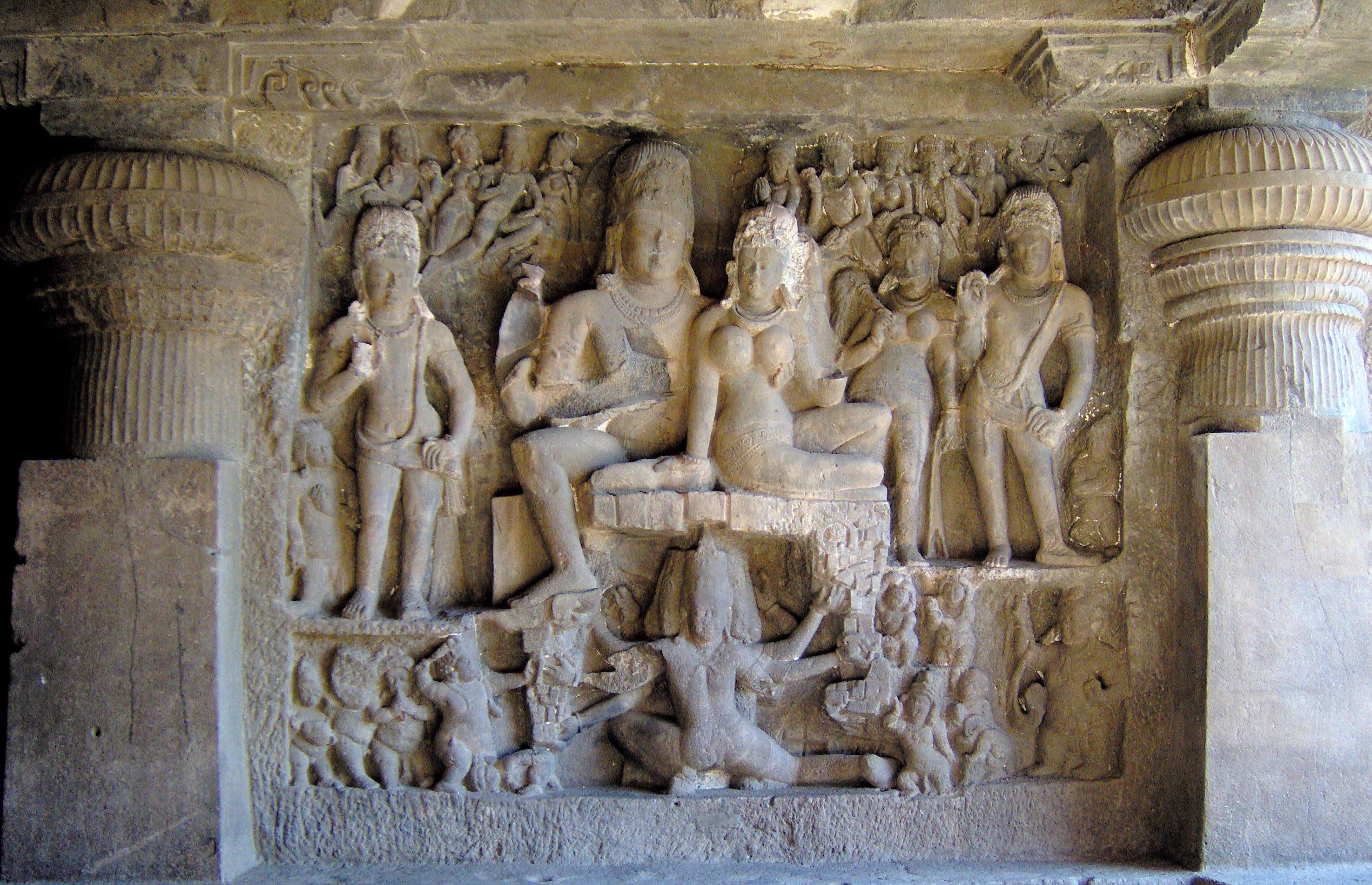
Siva and Parvati in an intimate posture in Mount Kailash as Ravana attempts to disturb them.Ravana will be severely punished by Siva for interruption and creating discomfiture of Parvati.
Ellora Cave 29.

Yet he is the super Yogi - Yogeswar.

Lakulisha - one of the greatest Yogi incarnation of Siva. Ithyphallic.
British Museum, London.


Wendy O'Flabberty  has brought out all the tales connected with Siva in her book : Asceticism and eroticism in the mythology of Siva'. This book was published in 1981 and as far as I know , created no ripple among Hindus in India - probably was overlooked . I have found this conflict has been  brought out in an extensive article  titled 'Shiva The Sensuous Yogi', published in the internet during April 2002 ) - refer to http://shiva.exoticindiaart.com/. Very likely, this article will not be accessible from India, because Siva is not portrayed as a celibate ascetic here and this theme is offensive and unpalatable to many Saivite Hindus .

Not only in India, but even among the more liberal society of Christians in the Western hemisphere, celibacy  is considered very important to religious order. But, unfortunately, the burden of life-time celibacy is not easy to  carry. There has been many scandals and power struggles in Vatican's history, at the root of  which are instances of  failure of people in religious order.

It becomes very much apparent when  I was reading internet sources  about  possible relationship between  Jesus and Mary Magdalene. My impression is that a large section of  followers of Jesus believes it would have been improper for Jesus to have a normal conjugal life .Without going into deep discussions about what were written and what were implied in the religious writings by his disciples, disseminated over centuries, let us read:
  • http://au.answers.yahoo.com/question/index?qid=20070227040110AAfvdD5, including comments
  • http://answers.yahoo.com/question/index?qid=20081217130718AAmugoz, and
  • http://www.straightdope.com/columns/read/1282/were-jesus-and-mary-magdalene-lovers, a 1998 article, published  much before the hype 'Da Vinci Code' generated.
to understand how segmented the view point is about this  relationship .

To-day, what we have about the life of Jesus is partly from the ancient writings ,their interpretations for centuries and troves of work of art.Enthusiasts have taken time to publish  collections of the best on Mary Magdalene in the internet I  was floored by the collection of 'Bible Art Gallery'.

Let us take a look at  the few that struck my heart :


'Noli me tangere'  ( John - 20.17) - Touch me not - by Titian. See how tender is Jesus in his refusal. He  is not walking away harshly, but, he has bent towards Mary Magdalene. When Buddha and ChaitanyaDev left the beds of their conjugal partners, did they bid  goodbye as tenderly?

Let us have a closer look at Titian's interpretation of the scene of parting :

Titian  added a sensuous dimension into this painting through nearly nude image of  Jesus. His naked body , clad by just a loin cloth, tells a story to the viewers, to those who are willing to listen. In direct contrast to the robed figure of Jesus in Frescos by Fra Angelico  and  Giotto .

Two of the best work on Jesus and Mary Magdalene are where one of the two characters is not present. First one is a sculpture ....clay to be turned to bronze , capturing the moment when, amid tears, she utters ; Rabbouni !!' ( which means Teacher). Jesus is not present in the composition, yet the viewer does feel his presence.


The 2nd one is a masterpiece by Mangegna -'The Lamentation over Dead Christ' . The viewer will feel s/he is standing at the position of Mary Magdalene, where the bruised feet of Jesus protrudes beyond the marble slab of the tomb chamber. This is a subdued  and highly acclaimed tempera work of this great artist.

The Lamentation over the dead Christ.
Pinacoteca di Berra, Milan.
  

My own  Comment :

Though many people  continue to debate about the relationship between Jesus and Mary Magdalene,  I feel, it is not very important to mankind if Jesus was celibate or not. He was a great preacher. If he found solace in a relationship  during the turbulent days of his life in company of the 2nd Mary of his life, so be it. Unfortunately for the mankind, his teachings on tolerance and love have been violated by his followers through centuries.

To me , it is important that he dies on the cross every time justice suffers  and hate prevails. In continents and in Institutions and at homes.

His teachings and Siva's present-day imagery - 'Shantam-Sivam ( Tranquil and Good) ' are the essences we can carry in our heart.


NOTES : 
1 A. FRESCO BY FRA ANGELICO - http://www.google.com/imgres?imgurl=http://www.lib-art.com/imgpainting/7/0/18907-noli-me-tangere-fra-angelico.jpg&imgrefurl=http://www.lib-art.com/paints/nolimetangere.html&h=1087&w=900&sz=173&tbnid=c7Z8QfpR8I8EKM:&tbnh=150&tbnw=124&prev=/images%3Fq%3DNoli%2Bme%2Btangere.&zoom=1&usg=__TosqnRUSmwZ5ZrhSv8yJnL3UK3Q=&sa=X&ei=FfJyTOCZIJTNjAfh0rT7CA&ved=0CDgQ9QEwCQ.
Museo di San Marco, Cell 1, Florence.
B. FRESCO BY DIOTTO - http://www.shafe.co.uk/crystal/images/lshafe/Giotto_Arena_Chapel_Noli_me_tangere.jpg
Capella degli Scrovegni, Padua

2. BIBLE ART GALLERY - http://www.bible-art.info/MaryMagdalene.htm

Friday, August 13, 2010

SIVA THE ICON - II


A book from National Geography.
A wonderful gift I received during 2010 trip to NY.

Siva's Blessings

After I completed the blog on Siva, I circulated an e-mail requesting a few friends to have a look at the same.

I received two responses - one from DJ Ray and the other from Suraj Nowlakha. I have inserted a quote from DJR's e-mail in the ' Comments' column.Suraj has sent a number of Sivalinga's photos . I did not include any Sivalinga's photo in my 1st blog on Siva.Here is the 1st one...that of Somnath temple.......one of the twelve photos he forwarded to me.


The Linga is made of white stone while the Yonipatta is covered with silver .
Milk drips from a bowl on the Linga to soothe the same.

I found an interesting photo of the 'Brahmanaical Triad' in a book on the Asian art collection of Brooklyn Museum ( Unfortunately, the day I visited this Museum, this section was closed to visitors) . This one is from Kashmir, an 8th century green chlorite sculpture. Here we find Brahma and Vishnu standing on the sides of phallic symbol of Siva. Brahma on the LH side has two geese which are his 'chariot'. On the RH side, we find Vishnu with a female and male figures on his two sides. According to the book, the female figure symbolises the mace Vishnu carries and the male his 'Wheel of law'.


8th Century Green Chlorite figure of 'Brahminical Triad'.
Source - Brooklyn Museum.

The most pleasant reward for all the work I did during my Library visits @NY came from Sujash, my elder son and his University-friend Miriam. On 7th August ,2010,we were discussing about NYPL @ Miriam's place over a lunch of salad, after a long walk @ 11oth Street and Harlem. Miriam enjoys reading and travelling. I mentioned the books I enjoyed reading during my visits, but could not copy as many pages as I wanted to ( because @ 30 p/page, the cost is high even @ USA standard) and the only book I could not find there. She asked for the list and yesterday ( 12th August) , I found a packet of three books as a gift from Miriam and Sujash.


The cover of this book has now changed. But, I could not copy the image of the cover from Internet source.


A remarkable book by a person who learnt Indian classical dance and created this wonderful collection of writings and photographs while
elaborating the nuances of Nataraj's postures.


Saturday, July 31, 2010

SIVA THE ICON - I


Tension between the imageries of Siva


'If he is naked what need he has of bow?
If armed with bow then why the holy ashes?
If smeared with ashes what needs he has with a woman?
Or if with her, then how can he hate Love?'


- 'Asceticism and eroticism in the mythology of Siva', Wendy O'Flabberty.Translation from a Sanskrit poem written perhaps around 1000AD.


Bhikshatana Siva - The Wandering Mendicant.Matted unbound hair, naked except a girdle of snake around his hip,wearing sandals ( the only imagery of Siva wearing a footwear ), skull of Brahma in his left hand. Siva is naked, but, not ithyphallic. A dog accompanies Siva.

Interpreting the intrinsic meanings of Hindu Iconography is a subject that requires scholastic understanding of our religious history, ditto of mythological tales and study of allied fields. As I glanced through some of the work on Iconography of Siva, written by Western writers during my visit to NY in 2010, I found the list of books and articles each of them referred to is simply enormous. Among the writings I went through,I was most impressed by the book of Anne Marie-Gaston, an exponent of Bharat-natyam herself, on Siva’s dance-form, as expressed in wall-reliefs in temples across India and Stella Kramrisch. The other books I could lay my hands are by Homer John Custead and Charles Dillard Collins.

Present day anthropomorphic image of Siva

It is quite well understood that the worship of Siva as a ‘Linga’ has a long history. But, Siva in his sitting posture, with the crescent on his matted hair, tiger-skin covering his loin, trident on his right-hand, is comparatively new. The first image of a Yogi, wearing buffalo-horns as his head-gear, sitting in a straight posture, ithyphallic – ‘unencumbered by a loin cloth’ is where we start from. This image ( see below) is from Harappa and probably dates back to BC. Was he a god of Fertility? Was he a Lord of animals – a ‘Pasupati’ among the non-Aryan gods? There is no answer yet.

A pre-Vedic age imagery of an ithyphallic Yogi, presumed to be a god of fertility and a Lord of animals ('Pasupati' )


Then we have Rgveda slokas,referring to 'Rudra', the Roarer .The Roarer was an archer too. But, Rgveda has no mention of Siva .One point is very clear – Siva is no vedic god. A lot has been written by serious students of Siva’s mythology on evolution of Siva/Mahadeva from the Yogi of Harappa , tension between Siva’s imageries as erotic/ascetic, benevolent/ferocious.

A coin from Kushan era.King Vasudeva ( 190-230 AD ) on the left. On the right, Oshio - probably derived from a Prakrit word 'HAVESA',representing the Sanskrit word 'Bhavesha', the Lord of Being. The ithyphallic god has his trident in his left hand and is accompanied by his bull. ( Note : 1)

Bhikshatana Siva - The Wandering Mendicant, at Darukavana. Wives of sages submit themselves to Siva as an cuckolded sage gesticulates furiously. Siva's finger is raised upwards, a gesture copied centuries later by a sculptor , who created a statue of Siva's disciple Sambandar (Note : 2)
Photo : Obliged to Sardonik , Trekearth.

Yet another depiction of Bhikshatana Siva . Parsvanath temple at Ranakpur, Rajasthan. Siva is not young and his hairs not unbound like the preceding image . Siva is naked, but, not ithyphallic.Wives of the sages are seen dancing around him.I did not understand the relevance of the dancing figures when I took this photo in Sept,2009... thus missed out the details of the RH side.

Among the mythological tales woven around Siva/Mahadeva , the most interesting are :
  • Beheading of Brahma.
  • Bhikshatana Siva and his encounter with the sages of Darukavana after their wives fell for Siva’s charm.
  • Dance of Siva after he vanquished the challenges of the sages of Darukavana.
  • Slaying of Gajasura. Destroyer of Tripura.
  • Dance of Siva after Andhakasura was tamed & Gajasura slayed. 
  • Hari-Hara.
  • Androgynous Siva.
  • Birth of Kartikeya.
Stone statue of Natesh Siva from Bangladesh.Siva dances on Nandi , not Apasmara.
Siva is  ithyphallic.
Through ages, followers of Saiva sect have added to their sacred text. The ‘tales’ have been written and re-written, trying to establish the supremacy of Saiva sect above the other. Upper class Aryans have come into the fold of this sect….yet a large group of those on the fringe of the society continued to be followers of Siva.
A painting showing Siva and Parvati in mountain Kailash, as Ravana shakes it.This imagery has been used repeatedly by Indian sculptors.

All these, specially the rivalry among sects, added much to the ‘twists’ of the tales. One point is clear…. There seems to a lot of conflict between Siva and Brahma in Hindu mythology. One of the Western writers I mentioned above has drawn an arrow diagram that portrays the conflicts between the two from the starting phase to development in the Bhikshatana Siva and Natesh Siva imageries. 
I have taken the liberty of using a few photos from the Internet .I acknowledge the debt with thanks.

Three manifestations of Siva - somber,benign and ferocious. Photo taken at Chittor, Rajasthan.According to Hindu mythology, Siva has eight manifestations -Sarva,Pasupati,Ugra,Asani,Bhava,Mahadeva,Isana and Rudra.

No blog on Siva's Iconography can end without a para on and a photo from Elephanta Cave. A very nice reference book is written by Charles Dillard Collins , title being 'The Iconography and ritual of Siva at Elephanta'.We find the earliest reference of this cave in the record of Gracio da Orta, a Portuguese physician and scientist,in the company of Portuguese sea Captain Martin Afonso de Soma. He wrote : '.....On the walls , all around,there are sculptured images of elephants,lions,tigers,and many human images,some like Amazons, in many other shapes well-sculptured..Certainly it is a sight , well worth seeing, and it would appear that the devil had used all its powers and knowledge to deceive the gentiles into its worship'. An useful link to an exhaustive album is at : http://www.google.com/images?q=elephanta+caves+pictures&oe=utf-8&rls=org.mozilla:en-US:official&client=firefox-a&um=1&ie=UTF-8&source=univ&ei=xFNUTPX1BcG78gavscX-Ag&sa=X&oi=image_result_group&ct=title&resnum=1&ved=0CCAQsAQwAA&biw=922&bih=520.

I have picked a nice photo from this album. The relief shows marriage of Siva and Parvati , again an imagery which inspired sculptors through centuries .


Siva-Parvati's marriage - Kalyansundarmurti. Elephanta caves. Source - Internet.

I end with one terra cotta panel from the hexagonal temple ( 19th century) of Ilambazar, Birbhum district , WB which shows an unconventional depiction og the Ganges coming down to the earth ...... she is not shown as coming down on the matted lock of Siva !


From left to right : Bishnu,Ganga riding on makara, Bhagiratha praying with folded hands,Siva, ithyphallic Ganesha and Bhagiratha looks up as the river flows down to the earth.

Notes :
2.View : http://postbalki.wordpress.com/2009/01/31/kolaru-pathigam-from-gnanasambandar-surprisingly-different-1/