Monday, February 27, 2012

TEMPLES EXTRA-ORDINARY : OUR VISIT TO TEMPLES OF ORISSA - PART -II

IN THE TOWN OF TEMPLES : PARASURAMESWAR TEMPLE

 Parasurameswar temple. 7th century AD.

 Bhubaneswar is a temple- town. Most of the temples are devoted to Siva.It is not him in 'samhara-murthy' - the divine annihilator - whom we find  here at Bhubaneswar. We see him as the divine source of energy of creation, symbolised by his 'linga' piercing the 'yonipatta'. Those who study temple architecture of India believe that Orissan temples' shape  has been developed imitating the shape of 'Siva Linga'  ++.

 'Koti Lingam', North court-yard,Parasurameswar temple.
Said to have 1001 'lingam' inscribed on the shaft.

Saivites of India  have evolved from sub-sects spread across this vast country through centuries and are of  much diverse origins than the followers of other Vedic gods Simply stated, Siva had his worshipers among various communities of  non-Aryans . Numerous tales of his deeds, which contribute to his characteristics and his imageries, have sources  across this vast country, recounted through the ages. Historians of Art have written pages about the same and will continue to do so. I submit here  in przmm.blogspot.com what I little I viewed through the lenses of my camera.

Eight-armed  Nataraja . Ithyphallic.
Partly damaged lower portion depicts torso of Bhringee
and legs of Nandi.

 To appreciate  the iconography of Parasurameswar temple, it is relevant to  understand the  timeline  of Saiva architecture of the centuries of 1st millennium AD * :
  • Virupaksha temple, Pattadakal was constructed by Queen Lokamahadevi in 745 AD.
  • Kailashanatha temple , Ellora caves was  started by King  Krishna I of Rastrakuta dynasty - his rule was between 757 - 773 AD.
  •  Mamallapuram - developed during 7th century AD.
  • Parasurameswar temple -  developed during 7th century AD.
 These years are important to understand  what I shall state in the next two paragraphs.

 Parvati embraces Siva as Ravana shakes Kailash.
Unperturbed Siva's right-hand is in 'Abhaya mudra'.

 Parasurameswar temple  is the oldest among the surviving temples of Bhubaneswar. Its style is remarkable. The temple faces the west, its Jagomohan has a second door which is south-facing , the  door to inner sanctum has 'Asta Graha'( Eight Planets) inscribed on it . The ninth planet - Ketu - made its appearance in later-day temples.North-west side of the temple's court-yard has a 'Koti Lingam'** installed.

A close-up of 'Siva-Parvati in Kailash'. Parvati sitting on 
left-thigh of Siva. Siva ithyphallic.

To me . more important is that this temple is iconography. On the western wall of its 'deul', just above the roof of 'Jagomohan', we see Ravana disturbing the union of Siva and Parvati @ Kailasa. There are Ganesa, Kartikeya, Bhringee and other characters around. Siva is unperturbed but Parvati is not. Now - if we refer to the timeline above, we shall find that 'Ravana lifting Kailasa' of Ellora and Pattadakal - so very well-known - have their predecessor here.

 Revelry of Siva  and his followers
Top row : Siva dancing. Lower row : Musicians among his followers.

Parvati getting ready for marriage

This temple's eastern wall has a big wall-relief of Kartikeya , on its top the scene of Siva's marriage, thus bringing in the memory of 'Kumarsambhamam' - 'Birth of Kumar (Kartikeya'), written by the famous poet of Gupta era, Kalidasa,  during 4th century AD. The 'energy of creation' - represented by union of Siva and Parvati -  manifests in  their embrace on the west wall and again on the southern wall , in their marriage scene  and Kartikeya on the eastern wall, in 'Koti Lingam' of the court-yard and the shape of the 'deul'.

Very elegant wall-relief of Kartikeya.
On the top band, marriage scene  of Siva and Parvati.
Surya and Brahma on right-side of Siva, 
while Himalaya and Menoka flank Parvati.

Parvati snugs close to Siva - ithyphallic.
 Their respective  mounts,bull and lion, are depicted in the wall-relief too.

 The 'Andhakasura' episode of Siva's mythology was prominent on the mind of  the Savite artists of this temple. We find Nataraja and Bhringee on the south and western walls, 'SaptaMatrika' on the Northern wall. There are other 'Parsa Devata' - gods depicted on the outer walls of the temple. But, significant are  : the marriage procession of Siva-Parvati on the west -face of Jagomohan and Siva - Annapurna on on the southern wall of 'deul'.I have not come across any Siva-Annapurna  during my visit to the temples of SriMukhalingam,Aihole and Pattadakal in February'2011 - I consider this wall-relief quite special.

Siva  holds out an empty pot to Annapurna.


NOTES on Sources : 
++1. A Bengali book on ''Mithuna' Iconography by Late Narayan Sanyal

* 2. Quoted from WIKIPEDIA.
**3. 'KOTI LINGAM' -  Literal meaning  - 10 million 'Lingam'. I have been told by the priest of this temple that there are 1001 'lingam' inscribed. According to a source, stones with Buddhist inscriptions have been converted to 'Koti Lingam'. This is, however, is an unverified staement and not meant to offend any religious sentiment.
I have seen another 'KOTI LINGAM' shaft @ Mahakuta (    near Badami) , Karnataka.


Thursday, February 23, 2012

TEMPLES EXTRA-ORDINARY : OUR VISIT TO TEMPLES OF ORISSA - PART -I

BHUBANESWAR/KONARK/PURI - PART - I

Lingaraj temple of Bhubaneswar.
A magnificent temple - now standing in a cluttered court-yard, instead
of a sprawling green environment like the Sun temple,Konark.
Strict imposition of 'No camera inside the complex' rule on the visitors deprive outsiders  a taste of excellent wall-reliefs n display.

This is a visit Ruby and I were looking forward to for quite a while. In November,11, we were mentally ready to make the trip. But, unavoidable family circumstances  kept us held up in Calcutta . Earlier also, we  found it is convenient to make a short trip in February - the weather is kind, it is neither so cold that woolens are to be carried nor one does not sweat while moving around for sight-seeing and  outdoor photography.  This particular Orissa trip  we planned  with photography in temples of  Bhubaneswar and Konark in mind as well as enjoying the sea coasts  @ Konark and Puri.

 RajaRani temple, stands out as the most elegant and beautiful 
among those at Bhubaneswar

We had quite an enjoyable trip. By and large, our compact  four-days programme  worked well. We were at Bhubaneswar for two days, 2nights and one day at Konark and spent  a few hours at Puri on the 4th day to pay a visit to temple of JagannathDev and sea beach.

The accommodation at both Bhubaneswar and Konark was good. Except for at one temple - Megheswar @ Bhubaneswar - 'panda'/priests did not harass us. We had several disappointments though. At Konark, we could not enjoy a sunrise. But, Konark temple enveloped in morning mist was a rare visual treat. Secondly at Puri temple, we had to remain content with glimpse of JagannathDev from a distance as all the three deities were to have a 'bath'. But, I could see young and not-so-young sweating devotees running along a corridor, carrying caskets of bath water  - never knew such a ritual exist !

Before I write a few paragraphs on  our visits to temples , a few general points ....

This auto-rickshaw took us around @ Bhubaneswar 
on 15th &  16th Feb.,'12.
 He would be unhappy even after we added a good tip on the exorbitant fare  he made us agree upon.

One remarkable feature of the Tourism department of Orissa is the excellent  repertoire of Travel literature they have developed to attract and assist tourists. The publication on Konark temple , Buddhist/Jain shrines and 'stupas', detailed map are amazing. OTDC  has developed a good network of Hotels . We could not have enjoyed our one-and-half days' stay @ Konark but for Yatrinibas.

 Yatrinibas, Konark.


 What we did not like is  general attitude of extracting money from tourists - through formation of cartels of taxis and auto-rickshaws as well as other service providers.Last year, when @ Hampi, I asked an auto-rickshaw driver  as to why the cost of a ride was so high there. He explained -  long no-tourist/small income season. It is not applicable to Puri and Bhubaneswar  - these places enjoy tourist inflow throughout the year. I found travel cost unjustifiably high. Public administration does not provide support to tourists through modest, clean and efficient point-to-point transfers.

  Beautiful 'Torana' ( arch) in front of Mukteswar temple

 The temples we visited @ Bhubaneswar, Hirapur, Konark and Puri are extra-ordinary in architecture as well as iconography. A discerning visitor will appreciate the depth of planning and meticulous 'execution' which attract  thousands of visitors through centuries to these places - not only for pilgrimage, but to savour  the wonders standing tall for centuries.

 Entrance to Udaygiri caves

RajaRani temple is the most beautiful one among those we visited at Bhubaneswar . Lingaraj temple is the magnificent one. Brahmeswar,Vaital,Mukteswar and very significantly ,'64 Yoginis' as well as Parasurameshwar temples are delight of students of Iconography like me. We also visited Sisireswar, Megheswar,Swarnajaleswar, Siddheswar temples.

 Konark temple,mystified by morning mist
February,2012

Next was the Sun temple at Konark - the most awe-inspiring temple in Orissa. It is said that had this temple been discovered before TajMahal during the British rule, Konark temple would have been considered one of the seven wonders of the World ! Whether or not  such a claim is proper, Konark temple overwhelms visitors with its design and details inspite of the broken deul and many scars. ASI has done a great job in developing the area around with well-manicured lawn and excellent 2-tone lighting. I enquired with the ticket counter and found during the peak season of November/December, upto 6500 visitors  throng to this temple in a day !!


More about the details in future blogs.

Thursday, January 19, 2012

CEILING ART IN TEMPLES @ AIHOLE & PATTADAKAL, KARNATAKA

COLLAGES  IN STONE !

Ceiling art in the Jain Cave  temple @ Aihole.*

I was quite keen about taking photographs of the mythological scenes on the ceilings  of temples @ Aihole and Pattadakal. But, it was a difficult task, specially @ Huchchappayana Matha , Aihole. There is a big stone-bull  right below  two reliefs on ceiling . Further, the light inside the 'Mandapa' of this 'Matha' was quite inadequate. Therefore, taking a position for clicking photos was extremely difficult.  There are three reliefs on the ceiling - each  very interesting. We took a dozen photos each, but,  only a few  could capture the details in a presentable frame . The other problem was flash - this robs the photos a lot of their appeal. Karnataka Tourism is very particular about not allowing tourists benefit of using a tripod. Though I carried one, I could use it at none of the locations.

At  Papanatha temple, Pattadakal. taking photograph  of the  ceiling was much easier. The ceiling  of the area @ the entrance - we can call it a porch -  has a wonderful wall-relief of Siva and Parvati in a pose of dance. The light was adequate, there was no obstruction on the ground level and no visitor around.I could just lie prostrate  on the ground and click.

 Siva and Parvati dancing.Their feet are crossed in 'Swastika' posture 
Siva's right-hand in 'Abhaya-mudra' and Parvati's right hand in 'musti' 
while her left hand in 'dola' posture

Here we find  8-armed Siva and Parvati dancing, in accompaniment of  Musicians and celestial dancers. All the four arms  of Siva's right side are intact, but, on his left side , three arms are gone.

At Huchchappayana Matha, Aihole, we have Trimurti - Brahma Vishnu and Siva - depicted on the ceiling, though not in this sequence.The first one  here  depicts Vishnu sitting on 'Ananta' the snake and Laksmidevi  and other goddesses & worshippers are around on his side. The limbs are drawn with very non-angular smooth lines. With time -  @ Huchchappayana Matha was built around 11th century - the faces have lost the details.

Vishnu sitting @ rajalila asana posture on Ananta the snake. The snake's coil is a little too small. But, Visnu's posture is very graceful - well-crafted.

Next in the sequence is Siva. He is sitting on his bull - Nandi's - hump  in lalitasana . Parvati  sits on his right side !! - has been offered a most uncomfortable sitting area on the back of Nandi. An attendant holds an umbrella on her head. Musicians and dancers revel around the divine couple. Siva's face show details, unlike  Vishnu's face, but suffered erosion.

Siva-Parvati on Nandi. Siva has 4 arms - he holds  two snakes in his two top hands. Siva's left-hand in Katakamudra. Parvati holds a lotus in her raised right hand.

Last in this Trimurti series is Brahma. He is seated on a rather small swan. He has 4 hands. Akshamala is very prominent. Among the hermits offering salutations to him, quite a few are  emaciated with just skin covering their skeletons . Brahma's face has suffered  erosion.

Brahma sitting on a rather small swan. And... the swan is resting on a stool, though its  wings 
are spread across. Brahma's feet also rest on this stool. Parvati and Brahma have not been shown in graceful sitting postures !

 The  ceiling art of Virupaksha temple,Pattadakal is of Surya in his seven-horses chariot - not any one of the Trinity. Very  seriously done arrt-work, with many charatcters of Surya's Iconography. Art historians can compare with the Poosha - the morning sun of Konark temple !

 Surya holds two lotus buds in his two hands - will they bloom as the day progresses ? his two consorts  strikes pose with bows - as if the arrows will pierce the darkness. Surya stands 'samapada' 
on two lotus. He wears no shoes.
Virupaksha temple,Pattadakal .

We have an elaborate  Kartikeya in the ceiling of  Huchchamalli temple of Aihole. Kartikeya's young face and physique is very carefully crafted. The peacock is quite proportionate in size - I liked this ceiling-relief very much.

   Kartikeya, Huchchimalli Temple,Aihole.

*NOTE : We have either missed out taking a photograph of the plaque outside the Cave temple or the plaque outside was missing.However, from the Tourist guides we have brought home, it appears that the shrine is called 'Jain Basadigalu'.

Saturday, December 17, 2011

AN OLD BUILDING IN RUINS @ JAGATBALLBHPUR,Dt : HOWRAH

ON YOUR LEFT  AS YOU PROCEED ON DOMJUR-JANGIPARA ROAD....


  Old-world Charm 1 - December 2007


Old-world charm 1 - now in real bad shape!
December,2011

We were standing in front of this compound wall of the old - perhaps 150+ years - ' Puja Dalan' of a once-wealthy family of this area  after a lapse of 4 years and a few days .

 Old-world Charm 2 - December 2007
Reportedly, Cinema & TV Serial Directors found this 'Puja dalan' interesting !

When we were here in December,2007, we found this building locked .On enquiry,  Ruby found the keys were available with a local shop - taking photograph was no problem ! Ruby did take a few photos  of  the interiorand these shots exude  old-world charm.


My friend (LH) with the present day Care-taker (RH).December,2011

This year, we found a care-taker staying inside who allowed us to go inside but, stopped us from taking  photos of the inside structure. Not that much could be captured as he  hung tarpaulins in the court-yard and reportedly use the space for tuition !!

Old 'Puja dalan' in plight - December 2011

Just imagine - tutorial classes in a heritage (?)  building !!
We found this care-taker somewhat strange - he is so much averse to photography that he did not allow anyone to take his photograph too ! He spoke big things about the ancestors of the owners of this building - they are descendents of  the 'Pal' dynasty.

Old-world charm 3. Pillars photographed in December,2007. 
The photos here are a mixed lot - a few are from what was shot in 2007 and others in 2011. If any reader knows the present owners, please convey our anxiety regarding the maintenance, the present use of the premises and the attitude of the care-taker to them.

Old-world Charm 3. A glimpse of the pillars inside, 
as viewed though an opening of the compound wall.
December,2011

The arches are so graceful, the 'Puja dalan' compact yet decent, getting ravaged by time and made UGLY because of greed of a private tutor.


Friday, October 21, 2011

DURGA PUJA/2011 IN CALCUTTA - 2

 Two Pujas which must  be chronicled in history  of  
 Bengal's   installation art  
                               & a few others                                 

I have noted one phenomenon in blogspot - I get regular hits on my very 1st blog on DURGA PUJA, which was published years ago while the latest blog on the same subject , incorporating 2011 Puja photos attract far less nos of hits !
Aisa kiun ? Aisa kiun ?? Aisa kiun ???

Behala Aikya Sammilani


Nevertheless, I continue my work of sharing photos from my HDD  with my friends . My wife and I enjoy visiting Puja pandals selectively - had we been younger, we could have moved around in the night. Here we have been around locally - only at Parnasree and around. Clicking photos of decorated pandals in the evenings is a pleasure - more so for us, because, we have fewer choices as we do not venture outside our area in the throbbing crowd of pandal-hoppers.

Earlier - during 1980s - my wife and I used to out with my mother and my sons during the evening of 'Sasthi' and never placed any problem in parking our car or accessing a pandal.This year, I found no place to park my car near the College Street pandal @ 7am on the morning of Dashami !

While sociologists will work on evaluating how 'Sarbajanin Puja' in Calcutta - and in districts too - changed over the decades promoting 'art of installation', specially with advent of participation of sponsors/advertisers, the revelers are never short of discovering wonders in every 'par' - locality. The very famous Puja at Naktala this year has taken the art of installation to a new height!

The pandal has been planned to look like a bird. The curvatures are inspired by a sickle . Tons of high quality timber has been used to build this 'bird' !

Lot of thinking, imagination has gone in creating the idol of the goddess. She is in  battle-mode - her being reminded me of Jiten Pal's creation of 1960s for 23Palli Sarbajanin. Several photos are required to convey the impression which has been built with metal and mehagani timber.

Durga rides the  'Mahishasura' - his posture shows he is about to be defeated. Durga holds his  left horn with her left hand and raises the sword which is also the trident  in her right. 


Durga in her fiercest mood.Her large eyes are angry. Her hair flying.
Are her two shoulders  at slightly different levels like a famous creation of a famous artist ?

The other Puja that requires mention was at FD-Block.THe idol is 52' tall - would not go for immersion.Reportedly, an urchin used to weep every year when Durga's idol sed to be taken for immersion. This year, the Puja Committee decided to go for a kind of near-permanent idol. Very proportionate is the creation - but Mintoo Pal has to explain my son's query - Why Laksmi & Saraswati are taller than Kartik & Ganesh ??

 This is the tallest Durga in 2011. There must be very interesting stories on how the concept was born & subsequently brought into reality ! If chronicles of these installations were written,
they would have interesting readings for us !

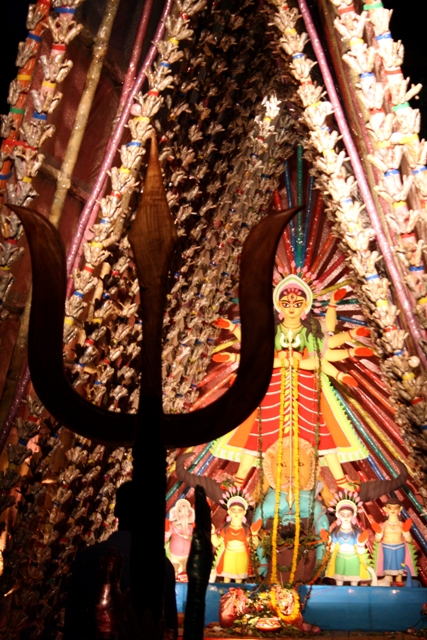
Demons, Lion and the Trident!


Pandal  created as 'Cave temple'. Idol  is a fusion of traditional & modern styles.
Kashi Bose Lane ( North Calcutta)


Tuesday, October 11, 2011

DURGA PUJA/2011 IN CALCUTTA - 1

ART OF IDOL MAKING in DURGA PUJA - 
SANATAN DINDA  - 
A SELECTION FROM OUR HDD

 Thousand eyes behold her as Devi Durga vanquishes Mahishasura , descends on the Earth with her left foot resting on the head of the Buffalo and  right foot  touching the soul of  mankind - floating horizontal in the cosmic void  . Hymns in Sanskrit add to the solemnity of this 'presentation' by Sanatan Dinda.
Nalin Sarkar Street,2011


Entrance to NSS pandal from Grey street.'Maner Manush' on a boat - coloured blue. Blue colour has been used on the nets which stretch upto the rooves of the neighbouring buildings - 
when lit up in the night, the boat-like structure  and the bluish glow of the nets 
create an impression of walking within a water-body.
Abstract designs and a large eye stare down  on the boat-like walk-way to the pandal.

Tara - the most revered among the Bouddha goddesses - has reportedly sprung from the tear of 'Avlokiteswar' - the most important among the Bouddha gods. She is the goddess of compassion  - and - also consort of 'Avlokiteswar'. Lotus blossom  and eyes are symbols of Tara. 
Sanatan Dinda has used the both in his NSS and Chakraberia idols this year ( 2011).

Since we returned to Calcutta from our decade long stay in Pune and Durgapur, Ruby and I made a practice of  visiting  Puja pandals selected , based on reports in Newspapers & TV. Our 1st Puja in Calcutta was in 2004. We were at Hatibagan to attend a 'barir' Puja  - a domestic Puja - when we reached the pandal @ Nalin Sarkar St while strolling around and clicking. Sanatan Dinda, seven years younger and much more accessible , was standing outside the pandal. That puja - the pandal and the idol - struck a chord in my heart. We had a chat  with Dinda , clicked a photo of him and left.I  decided to keep a track of Santan Dinda's work in coming years. Next time I saw his Durga idol - again @ Nalin Sarkar Street - was in 2007.
 
 Dinda made this idol for NSS in 2004. The pandal, shaped like a temple was designed and executed by him. Durga's idol has a bronze-like finish and very prominent & big eyes. Miniaturisation of  her 'children', lion and Mahisasura  - which later became his trademark - can be noticed in this 2004 installation too.

This is Dinda's Durga for NSS puja in 2007. Her face is nearly conventional, slightly heavy in the chin. Like in 2004, her skin colour is golden. Not 'ataseebarnabhyang' !

We returned to Nalin Sarkar Street this year ( 2011)  just to enjoy the presentation of Dinda. We were very much impressed by Chakraberia Sarbajanin  - the idol by Sanatan Dinda and the pandal by Shibshankar Das. From photos in the newspapers, it was obvious that NSS idol  and the pandal - both executed by Dinda will be worth a visit. And... it was.

At NSS, Dinda's 'theme' was 'Maner Manush' - a coinage from the title of a successful Bengali movie.
'Maner Manush' , which translated literally, means 'The Person in our Heart'. But, mysticism wraps these two simple words -   the meaning is 'understood' only by a 'sadhak' - someone who knows the specified process of meditation.In this installation at NSS , Dinda has succeeded in creating a mystique environment,  used various symbols and an idol which is the result of seamless , but, complex fusion of Hindu and Bouddha Tantrk iconography !

Dinda has borrowed from Bouddha Tantrk iconography in Chakraberia Sarbajanin too. But,  Dinda's  Durga idol here is 'brushed' with less complexity.   Shibshankar has built a pandal in a restrained manner . He did not attempt to dazzle the viewer with lots and lots of artwork and details.

 Devi Durga rises from 'pralay jaladhi'- cataclysmic ocean, standing on the 'jiban taranee' - boat or ark of life . She defeats 'Madhu-Kaitava'-like demons . ''Maner Manush' - soul of mankind - lies stretched in  front of Devi with a lotus in his folded hands. 
Lotus adorns Durga's being, her crown .
Chakraberia Sarbajanin, 2011.

'Maner manush' - The person residing in our heart - lies prostrate on a contraption protruding at right angles to the boat while offering lotus as 'anjali' to Durga.

Pandal of Chakraberia Sarbajanin. Shibaprasad created a wonderful environment using 'shephsl/shiuli' flowers and lotus. He used exhaust fans to create the 'shephsl/shiuli' flowers !
( Photo : courtesy - Ruby Chatterji)

I have no intention of  comparing  CS with NSS -2011. Such a comparison will no way increase the enjoyment & appreciation of these two very fine Puja pandals and idols. I have posted several photographs of 2011 Puja  - please do enjoy ! I have also tried to write a few words on evolution of Dinda's style  - what I termed as 'fusion' earlier in this blog with photos from my HDD and internet.

r
 Sanatan Dinda, visibly younger, in  2004 ,was photographed interacting with viewers  (Ruby ) in front of NSS pandal . It was noon of Saptami puja.

Friday, September 30, 2011

FROM MY 'DURGAPUJA' COLLECTION

 WORSHIP  AND FESTIVITY


When I went back to  HDD of my computer, I  discovered that I have not clicked many photographs of the crowd and events around Devi Durga. As far as possible, I have pointed the lens high above to shoot the deity's images  as we covered one 'pavilion' after the other. Therefore, a selection was easy. Not as good shots as I would have taken , if done consciously for writing a blog.

The first shot that I have selected is that of a priest who looks so small in front of the huge image of Devi. He was performing 'Arati' - adoration of  Devi and then the devotees jostle for seeking her blessing.


   As 'arati' gets over, devotees circle round the priest seeking the warmth of the lamp - 
blessing of the Goddess.

Have you ever tried to move around festive Calcutta in the mornings of the celebration days ? It is much easier to navigate as the crowd has gone home. One misses the lighting, but, there is no push and jostle.
Two of my early morning shots are here.

Dozing Drummer

Intense watching !
I could never discover what is funny in this Vodafone banner !

When 'bhog'  - food specially prepared for Devi - is offered, it is customary to have a stretched saree across so that devotees cannot 'see' Devi accepting the offering.

Buying a balloon ?? 

Who is the best dressed 'Devi' ??