Saturday, March 14, 2009

A TALE OF RETRIBUTION FROM MYTHOLOGY


THE TRAGEDY OF A STYGMATISED FEMALE CHARACTER FROM HINDU MYTHOLOGY


It was another tranquil evening in Dankaranya. After the sunset, birds were quiet…. the forest did not betray any movement. Mild fragrance of wild flowers hung heavy among the trees . The river Godavari was flowing as usual. Stars were shining on the sky above. Neither the river nor the sky betrayed any fore-bidding of an epoch of the millennium which would have its first act unfolding next morning in this forest .

This evening , a young woman was reclining on a flower decorated divan. placed on a raised platform adjacent to the river’s bank. Her supple athletic body betrayed slight tension. Her companions had lit up the platform with decorative lamps and placed incense sticks in its four corners . One of them was playing a stringed instrument softly. Her favourite masseur was ready with lukewarm oil, mixed with herbal ingredients and bowls of warm water, waiting slightly impatiently for the touch of her sensuous body his deft fingers would get during this chore and the pain of his ever-unfulfilled arousal. Her favourite snacks and drink were ready on a silver platter placed near her divan. A perfect set-up for relaxation of this special woman who spent the day riding through the forest on horse-back and hunting.

One of her companions came near her with slow-burning camphor, soaked in aphrodisiacs. She informed her that three young satraps of this forest were waiting in her pavilion .......invited to join her for a sumptuous dinner and later a session of
wild revelry and dance to the tune of orgasmic drum-beats .

But, her mind was wandering far away from this set-up and another evening of heightened pleasure. She was staring at the flicker of light coming from a distance through trees of this forest. She was intrigued by the dwellers of the sprawling cottage where the light was coming from. This cottage came up after she last visited this favourite hunting place of hers. She was , therefore, naturally curious about the dwellers of this cottage. She found there were three persons in this cottage. Two young men, one practicing archery and the other repairing the thatching of the cottage….. and a veiled beauty, humming and watering the creepers on the fencing. One thing she noticed : They were so different from all the people she knew in the power circle she belonged to.

This woman was no ordinary person. Her father was a very respected sage, her eldest brother a very powerful king, dreaded for his exploits of kingdoms and women, and her half-brother the richest person of the universe. Enlightened and sophisticated woman she was, with huge resources placed at her disposal. Her prowess has attracted many virile men to her inner circle. But, for the first time in her life, she felt attracted to a man, in a way she could not fathom herself.

These three persons staying at the distant cottage were no ordinary persons either. But, they were busy with their lives, having no idea what would befall upon them the next morning , when their neighbour would walk into their cottage with an unexpected request. The course of event would change not only their lives for ever but those of thousands whose existence they were not yet aware of.

This was the night before the start of a war Gods would watch with trepidation. One of the greatest poets of India will write an Epic based on this war . Can you guess who this woman is ?

She is Soopananakha, grand-daughter of sage Pulastya, daughter of Visrava and Kaikasee, sister of Ravana and half-sister of Kuber. Next morning, she would put on her best dress, jewelry and demeanour , and offer herself to the archer she saw from a distance. The other young man , the archer’s younger brother, would jeer at her dark skin , taunt her for her amorous advances and throw her out of their cottage . Losing her cool, she would turn blind with rage and create a ruckus. In a cruel act of retribution by the younger brother, she would be disfigured permanently.Her bodyguards would be killed. Soon, her eldest brother Ravana would abduct the veiled beauty to avenge this insult. A devastating battle would engulf her country bringing in immense tragedy into the lives of the all the valiant relatives of Soorpanakha as well as to the person she wanted to allure into her life.

This is a tale of India millenniums ago. To-day , Anurag Kashyap finds her heroine carrying a bed-roll to the shade of a tree and inviting her lover Dev D to have sex with her. Dev D disappoints Paro and the audience . Tragedy follows but, of a different kind and scale !


A conventional portrayal of Soorpanakha under attack - Jorbangla temple ,Bishnupur

Wednesday, March 4, 2009

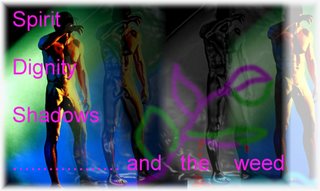
MAN UNDER SHADOW


Man walks into shadow.

Yet exposed to the forces from the dark !
He would not know what awaits him.
Shelter, respite or a tunnel downhill.


Darkness envelopes him... his manhood.
Weeds tie him down.
Will he emerge into light again?

PS : This collage is PSed from a photo of a nude in the internet.

Thursday, February 26, 2009

DELHI - 6 : A JOURNEY IN SEARCH OF A MIRROR FOR YOUR SOUL !


When Ruby and I went to view Delhi - 6 yesterday evening, we were not too sure if this would be a worthwhile experience. We went to a picture hall after ages.... all our viewing now-a-days is through television !

As this film by Rakeysgh Omprakash Mehra started rolling on the huge screen in front of us, we could not but admire the superb quality of cinematography and music and fine characterisation by he main actors. At the same time , we admired the restraint ROM has shown in editing so that no shot drags on.

As the story unfolded, we saw how brilliantly Mehra has developed the story towards the climax scene-by-scene and brought the viewer standing in front his/her soul's mirror ! Ruby and I stood stood back in the cinema hall, with a few fellow-viewers, watching the 'mirror' Mehra presented at the end of the show framing the actors , deeply moved by this film, by the total experience . We came out of the picture hall convinced that only a Director of ROM's calibre could visualise and deliver a film of this quality.

Do go .... and view Delhi-6. It is not a feel-good movie. It is different from RDB. But, with no less a serious message, no less intelligently compiled !

Some artists are just brilliant : Rishi Kapoor, Waheeda Rehman and ... of course, Abhishek bachchan. Wnat a restrained performance he gave ! At every moment during the viewing, we saw 'Roshan' standing in front of us and not an actor whose name is Abhishek Bachchan.

Mehra's slips are easy to find. Many reviewers in Newspapers and TV-shows have done that . We are glad that we ignored the comments of such persons and did not miss out this film !

Once again : Please do go .... and view Delhi-6.

Tuesday, February 10, 2009

MALE-BONDING THROUGH MY CALWALK LENSE


DURING A HOLIDAY FOR WAGE EARNERS

When I was going through the photographs I took during my 'Calcutta Walk' in January,2009 ,I thought of writing a blog, a photo-feature on male-bonding , as captured during street photography.

Young man, staring at his friend through
a mirror
of road-side hair-cutting saloon

My friend K, his nephew and I were out on the streets of Calcutta last month to visit a few churches and Synagogues of Central/Business district of Calcutta and do a bit of street photography as well. It was a Sunday... roads were empty and the we could have relaxed stroll through the footpaths of otherwise busy area. Food-stalls which remain busy throughout the week were empty.No carts on the roads.Shops with their shutters down.People sleeping, chatting, getting a hair-cut and strolling idly. On close scrutiny, we could realise that these people are mostly from our neighbouring states who undertake the menial's job during the week, earn their wages which go for the distant families' upkeep.


One thing that the photos bring out is the open expression of male-bonding. I read an article the other day in a newspaper where a Westerner has been quoted saying how often in India we find men strolling in public places holding hands! In Calcutta, there is another public expression of male-bonding : conduct of men bathing in public water faucets is somewhat similar to locker-room bonhomie !

Man scrubs his body and crotch while staring at that of his mate.


Well, Calcutta is unique among other metropolitan cities of India in this area. Calcutta has a river with numbers of ghats on its western fringe, numerous water-bodies and always-flowing road-side faucets. Scenes of half-naked migrant labour taking bath in public is a common scene. Bathers assemble in twos, threes as well as in groups , have fun and sometimes behave a little lewd.

A bather looks at his hard-on while his mate reaches inside his crotch for ablution!


Hmmm... may be Eve Sedgewick ( writer of Between Men: English Literature and Male Homosocial Desire ) can evolve her theories on homosocial behaviour of migrant workers of Calcutta. She believes that that the term 'Homosocial' predates her in occasional usage, with a generic meaning: "'Homosocial' is a word occasionally used in history and the social sciences, where it describes social bonds between persons of the same sex" . Sedgwick's contribution, however, is the notion that the boundaries between the social and the sexual are blurry, fuzzy; thus homosociality and homosexuality are connected and can never fully be disentangled. She acknowledges that the nature of this boundary varies from society to society and from era to era, and even within one society. ( reference matter - wikipedia) .

Two persons sleep cozy in a make-shift bed through the lazy Sunday morning.

I post here a few photos with my observations and comments. I felt that some of these photos need a bit working through Photoshop , adding a bit of drama. Others are in black & white.

This subject is interesting to a street photographer . More of this in future.

Sunday, February 8, 2009

TERRA COTTA TEMPLES OF BENGAL - VI

A JOURNEY THROUGH THE STRING OF BEAUTIFUL TERRA COTTA TEMPLES


Our dear Loken'sir' (Administrtor of group 'Banga' in flickr.com) suggested that I write about my current trips to Guptipara and Kalna after he read my last blog in przmm.blogspot.com. I wrote out the following note in the 'Discussion ' tread of 'Banga'.


3024_Ramcandra_west

WESTERN PILLAR OF RAMACANDRA TEMPLE @ GUPTIPARA


Hooghly district has a very rich heritage of terra cotta temples : Antpur, Bansberia, Guptipara and Kotulpur ( different from the village with near-identical name in Bankura district).

IMG_3648_2

WESTERN FACE OF RAMACANDRA TEMPLE @ GUPTIPARA

Bansberia, Guptipara and Kalna ( of Burdwan district) are on the same rail ( Eastern Rail: Katwa section ) and road (Delhi Road -> Assam Road ) route. With careful planning, one can cover two of these three places in one day. But, Kalna has a large numbers of temples spread across the township…..in fact, Kalna has a very deep religious history. Though a good no of these temples are located in the same area, yet an ardent student of Bengal's religious structures can keep him/herself engaged for one full day.


3658_brndbncandra_w

BRINDABANCANDRA TEMPLE @ GUPTIPARA

Ananta Vasudev Temple @ Bansberia was constructed on 1679 AD . Ramcandra Temple @ Guptipara was constructed on AD . Pratepswar Temple @ Kalna was constructed on 1849 AD . All these temples have excellent terra cotta work on them, based on scripture as well as depicting the social scenes of those days. BrindabanCandra Temple @ Guptipara was constructed on 1810 AD. An aatcala temple with imposing size ( 60’ height) , it has paintings on the pillars, inside walls and ceiling ( beautiful painting of Saraswati) of the inside verandah and garbhagriha. The Temples’ complex @ Guptipara has two other temples, one of them being an early example of Jor-Bangla style.

Laljiu’s Temple as well as KrsnaCandra Temple have awe-inspiring structures with 25 spires. The later has terra cotta work of good quality too. They were constructed on 1739 AD and 1751 AD respectively.

3980_view_rasmanca_w

KRSNACANDRA TEMPLE @ KAL, VIEWED THROUGH OUTER ARCHES OF RASAMANCA

Beyond these facts lie treasures of work….. of artists who created the oeuvre and those who ‘planned and visualised’ the same. We know little about these persons . I marveled at the Ramayana scenes , Rama-Krsna-Caitanya and the boats of Bansberia’s temple ; Nikumbhila yagna of Indrajit with Laxman and Bibheeshan stealthily approaching the site of yagna,gods viewing the Rama-Ravana battle from the sky, angry horses , Ruma ( ?) cowering under phallic prowess of Bali, monkeys toiling to construct bridge across the sea of Ramcandra temple ; Durga flanked by Ravana-in-prayer and Rama-in-harness postures , Kirtan singers of Navadwip, Krsna-Gopis reveling in Rasa-leela @ the top level of Pratepswar temple and the social scenes of Pratepswar and KrsnaCandra temples .

3924_krisnaRadha_1_w

KRSNA-RADHA & GOPIS IN ATTENDANCE : PRATAPESWAR TEMPLE @ KALNA.

3888_NE_w

NORTH-EAST CORNER,PRATAPESWAR TEMPLE @ KALNA.

While I am working on editing of the 450+ photos we have taken during these two trips, I share a few of with my friends here and flickr.com. I shall be very happy to render any help to a visitor of these places.

Friday, January 9, 2009

TERRA COTTA TEMPLES OF BENGAL @ GUPTIPARA-V


BrindabanChandra cluster of Temples at Guptipara,West Bengal

Guptipara is in Hooghly district, about 75 km by train or car from Calcutta.Story goes that this place used to be called 'Gupta Brindaban' during heydays of Vaishnavite culture in Bengal during 16th-18th centuries, from which the name Guptipara has been derived .

We were to travel to this place on 2nd January,09 with our extended family by car.But, autorickshaw fiasco in Calcutta, ably mis-handled by political parties and WB administration created a fear psychosis and we dropped the plan of traveling by car.This was to be our 1st outing planned this winter . Ruby nudged me hard ...... we went to Guptipara the next Sunday, 3rd January,09 , by train. It was a perfect day out, except for delay in reaching the destination, because the train we targeted was not plying on a Sunday from Howrah and the choking crowd we faced during our return journey from Guptipara station to Bandel.

Behula and Guptipara stations are equidistant from this cluster of four temples we were to visit.
The riverine Behula has lent her name to the station ( Behula) we got down to reach is cluster . As expected in a sunny winter day in Bengal, a visit to a village cheer up the city dwellers in us. We rode a rickshaw to reach the temples.The first of this lot, SriCaitanymandir, was built in the late 16th or early 17th century, was built in Jorbangla style.

From L to R : KrsnaChandra, SrCaitanya and BrindabanChandra temples

The other three temples were constructed between 18th and 19th centuries.The layout is simple. As one enters through the arched entrance , he faces the imposing structure of Brindabanchandra's temple straight in his front, across a nicely maintained green courtyard.The other two temples are on the western and eastern sides of this court yard.

60' tall Brindabanchandra's temple, constructed in 1810 AD is the most imposing of the three.It has a lot of paintings in the covered space in front of the garbhagriha of deities. The ones in the lower level bear mark of vandalism and wear, but , the ones beyond human reach are in good shape. The paintings of Lakshmi and Saraswati near the ceiling , though in need of touch-up, are really very impressive. Impressive are the idols of Krsna,Radha,Jagganatha, Subhadra and Balarama and Garura within the sanctum.


From the point of view of a pupil of iconography of terra cotta work, Ramchandra's temple is wonderful. It has a lot of panels all over the western side .and above the arches of the southern side . A temple with aatchala construction, the octagonal-shaped 1st floor's walls have nice panels too.While some of the details at the eye level and below on the western side......mostly on Krsna lila and social life......are imitations of AnantaBasudev temple of Bansberia , the ones on arches are excellent.

Lord Bishnu on Garura and Lord Shiva on Nandi

We find gods at the topmost level watching the battle of Lanka.On the southern side, two panels on Bali are noticed at the flank of the Gods.This oddity in placement may be the result of errors in layout creeping in at the time of recent repair work . Study of these two walls, overlooking such errors in other areas as well, is quite rewarding. Among the more interesting panels we saw, I mention a few here for serious visitors of Guptipara :
  • Meghnad starting 'Yagna' under a banyan tree, with Gods and rakshasas watching while Lakshman and Biveeshan approach fro a distance.
  • A woman cowers in Bali's presence.
  • Indrajit fondling Pramila.


  • Banar sena ( Army of Monkeys) carrying stones for construction of bridge to Lanka.
  • Bali and Sugriba uproot trees during their fight .
  • Acrobats' tricks.
  • Five women deep in water.... a scene from Krsna lila ( sadly, the photo came a cropper).
We shot about 250 photos, including quite a few of the chariot Guptipara is famous for and the surroundings . I hope you have enjoyed the few of the edited photos I have published here.

NOTE dtd. 21/01/2009 :
I have been asked : how one reaches Guptipara from Calcutta.


Well, best would be to travel by road.


To reach Guptipara or Behula station by train, one has to take a Katwa-bound train from Howrah or reach Bandel and then wait for the next Bandel-Katwa local.From either of the stations,BrindabanChandra temples cluster is equidistant. Rickshaws or cycle-vans are available mode of transport.


A through train takes 1hour 50 minutes/2 hours to reach Behula.Add another 30 minutes for the local transport. A serious viewer can keep at least 2 hours for his/her visit.Temples' gates open at 3.30 pm. Return train journey upto Bandel will be uncomfortable.For a comfortable return journey to Howrah, I shall suggest a change to Bandel-Howrah local.


We found these discomforts of train journey rewarding.

Saturday, December 27, 2008

OUR DAY OUT ON CHRISTMAS,2008

Enjoying a day out !


Well, Calcutta got relief from an unusually warm winter only a few days ago. We woke up at 6 am as light crept through the windows of a clear and crisp morning.A holiday means traffic-free roads and strain-and-hassle free driving!

Ruby and I got ready to spend the day out. No morning-walk .We had a quick break-fast, took out our cameras and rolled out of our garage. Later I checked and found that we drove 81 km till the evening.

First we to the Race Course of Calcutta to capture a view of the sky-line , as vi wed through the early morning haze.We found the horse-trainers are leaving the ground after the trots and other exercises.....to capture the same, we would have to come earlier.While I struggled to capture a view of the outline of Victoria Memorial Hall which was on the eastern horizon, Ruby captured some interesting shots of horses and their riders. ( I have borrowed one shot from hers). As we left the ground , we came across two interesting subjects for photography : a herd of goats and several tea-vendors with their ware of kettle/oven combo and plastic cups .


View of outline of Victoria Memorial Hall in distant east of Race Course of Calcutta.

Hordes of goats going past the gate of Race Course.

Tea-vendor outside the western gate of Race Course

Rest of the day was spent among 4 families.This meant a lot of driving from west to north-east to south-east and back to west of Calcutta..We had lunch at one of Ruby's aunt's place (Rajpur) which is 25 km from where we live. Their house has a balcony opening to a large pond and a foot-ball ground .Sitting in this balcony,we enjoyed frightful quantities of sweets after a sumptuous traditional Bengali lunch while watching hordes of locals braving the December chill as they took dip in the bathing 'ghat' of this pond in a sunny afternoon .

A traditional Bengali lunch. Fried rice,'dal'(gram),fried 'Bhetki' fish,curries of 'paneer'(home-made cheese) and egg.

Sweets....... loads of calories !!


Bathers defy December chill!

There is a famous temple of 'Goddess Kali' in this locality where a large crowd gathered in the afternoon to offer their prayer. The Goddess rides a lion , which is a departure from the traditional imagery of 'Kali'. Those who were selling photographs of the Goddess were of no help in offering an explanation. We offered our prayer and Ruby took several photos before we left for Calcutta .

'Bipattarini Kali' at Rajpur.

We drove back to Calcutta while the sun bade us good-bye.